
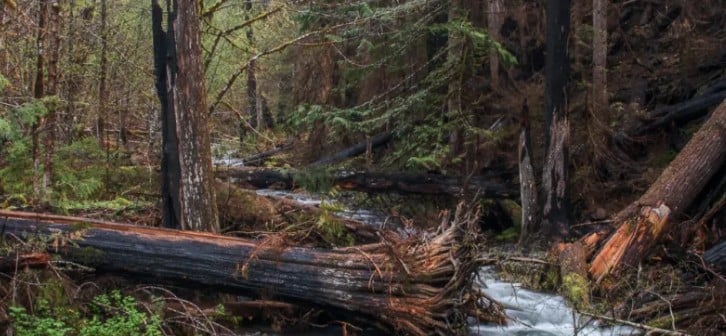
It turns out, watching a log break down is a lot more interesting than it sounds, though it does take several decades for a plot twist. In the Andrews Experimental Forest, located within the Willamette National Forest in Oregon, researchers have been studying the role of dead plant matter, specifically dead trees, within an ecosystem. Until the 1980s, it was the tradition that dead snags and fallen logs were removed from managed forests, because they were believed to increase the spread of plant pathogens and wildfires. Removing all those dead trees was costly, though, and ecologists were starting to wonder what purpose, if any, those dead trees would serve if left to their own devices. So, beginning in 1985, dead trees were left where they fell, so scientists could start looking into how they were decomposing, how nutrients were moving from the tree into the ecosystem, and what factors controlled how fast a log decomposed into mulch.
The first result was monetary in nature. Leaving fallen trees in place, instead of carting equipment into the forest, cutting up the tree, and carting the same equipment, plus the tree, back out of the forest saved Willamette National Forest upwards of $10 million a year. When it came to studying the logs, in the beginning, the logs were biopsied every year. This involved meticulously cutting out a cross section, or cookie, from the log; labeling and photographing it; and then separating and drying out the different kinds of wood present in the cookie and weighing each portion. As the years went by, the researchers leading the study started to spread out their log sampling. Now in its fourth decade, the research has already shown some large differences in the rates of decay amongst both different species of tree and amongst the different forms of wood. Earlier on, ecologists learned that fallen logs leached large amounts of organic matter, and that mushrooms were transporting huge amounts of nutrients from logs to the forest floor.
More recently, scientists at the Andrews Experimental Forest were able to observe how fire would affect log decomposition when a wildfire burned through a portion of the study area in 2023. Afterwards, the research project ended up with three study areas of unburned logs, and three study areas full of burned logs, which created the “perfect study experimental design”, as one of the lead researchers, Dr. Jacob Bukoski, stated in a Sierra article published on August 20, 2026. He and a colleague, Dr. Georgia Seyfried, thought that charred logs wouldn’t be as biologically active as the uncharred ones in the unburnt study areas. It turns out, the opposite is true, which now has the scientists thinking, why is that the case? While funding issues in recent years have made it harder for scientists to continue some of the long-term studies conducted at the Andrew Experimental Forest, the hope is they will have many more decades to answer that question, and all the subsequent questions that have come from forty-plus years of watching logs rot.
#ForestEcology #LongTermResearch #Ecosystems #WetlandWednesday #TheSwampSchool