
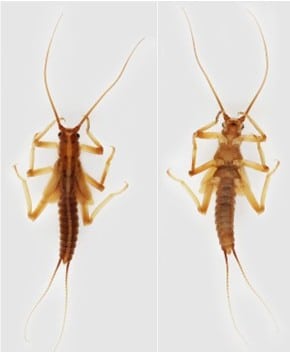
Dorsal and ventral view of a winter stonefly nymph in the Taeniopterygidae family. Photographs courtesy of Macroinvertebrates.org
Fall is finally here in North Carolina, though with temperatures reaching the nineties, it still feels like summer. While many insects are battening down the hatches and preparing for winter, some are just getting started. This month’s Weird and Wonderful focus is on one such group of insects: the winter stoneflies, Family Taeniopterygidae. Stoneflies, which comprise the insect Order Plecoptera, are an important group of macroinvertebrates (creatures without a backbone that are large enough to be seen with the naked eye) because their presence or absence within streambeds as nymphs is an indicator of how clean the water is. Winter stoneflies are a unique group because they emerge from the aquatic, nymph form into their terrestrial, adult form during the winter months.
So, what exactly is a stonefly? I’m glad you asked! Adult stoneflies are soft-bodied insects and are not very brightly colored, instead ranging from dull grays to dull browns. Most adult species have four membranous wings on their dorsal (back) side that lie flat when at rest, and the adults are capable of flying from one spot to another over short distances. Some species of stoneflies have been documented exhibiting abdominal drumming, which are vibrations that they produce by their abdomen against the substrate. It is thought that this drumming behavior is a way for adult stoneflies to communicate and find each other in order to mate, which is a pretty weird and wonderful feature, if you ask me. Adult stoneflies only live for a couple weeks and spend most of that time engaged in mating and, for the females, subsequently laying eggs in streams, often the very same streams they themselves emerged from. Life cycle studies performed on members of the Taeniepterygidae family show that most species take one full year to go from egg to nymph, and then to adult.
Many people are more interested in the nymph stage of stonefly development, which is fully aquatic. Most stoneflies within the Taeniopterygidae family are herbivores and/or detritivores as nymphs, meaning they feed primarily on submerged vegetation and/or decomposing organic matter. Winter stonefly nymphs in this family can be found in permanent streams in the North Carolina mountains, piedmont, and coastal plain, though not all species can be found across all those regions. The nymphs are often found on submerged leaf packets, submerged plants and tree roots, and other accumulated debris within streams.
In terms of pollution tolerance, there is a wider range within the winter stonefly family, with some species being able to survive in waterbodies with lower dissolved oxygen, while others require faster moving streams that are of higher water quality. Overall, though, stoneflies are some of the most intolerant stream macroinvertebrates when it comes to water pollution. Too many chemicals, not enough oxygen, and even too much sediment present within the water is enough to make a stream inhospitable for winter stonefly nymphs to survive.
As previously mentioned, winter stoneflies, and the rest of the stoneflies within Order Plecoptera, are important biological indicators of water quality. When combined with the presence or absence of mayflies (Ephemeroptera) and caddisflies (Trichoptera), these insect orders form the “EPT” index. Insects within these three orders typically need water that is free of chemical and sediment pollutants and has a high oxygen content. Essentially, the more species of these three insect orders that are found in a stream, the cleaner the water tends to be. Thus, being able to accurately identify a stonefly from a caddisfly or a mayfly, and then being able to identify it to the genus and species level, is a very important skill set that stream biologists and entomologists focusing on EPT species must develop. Workshops teaching that skill set often involve preparing collections of nymphs and adult forms and identifying them with the use of dissection microscopes and specialized taxonomic keys.
In addition to their importance as water quality indicators, stonefly larvae are important sources of food for many freshwater fish. There are many great field guides for EPT species out there geared specifically towards anglers, because fishermen pay close attention to the hatching times for stonefly species throughout the year. The nymphs are used as live bait, particularly for large sport fish such as trout and bass. For those of you who feel the urge to go and play in your neighborhood stream, take a gander at the North Carolina Department of Environmental Quality’s Benthic Monitoring Data map. There, you can see what water quality ratings different water bodies within the state have, based on what macroinvertebrate species were found there during sampling. The cleaner the stream, the more EPT species and other stream macroinvertebrate species were found there during sampling. Stoneflies, weird and wonderful creatures of two worlds, while small and often overlooked, are an extremely important part of our state’s ecosystem.
#Stoneflies #WinterStoneflies #Plecoptera #EPTIndex #BenthicMacroinvertebrates #StreamHealth #NCDEQ #NorthCarolinasWeirdandWonderful #WetlandWednesday #TheSwampSchool