
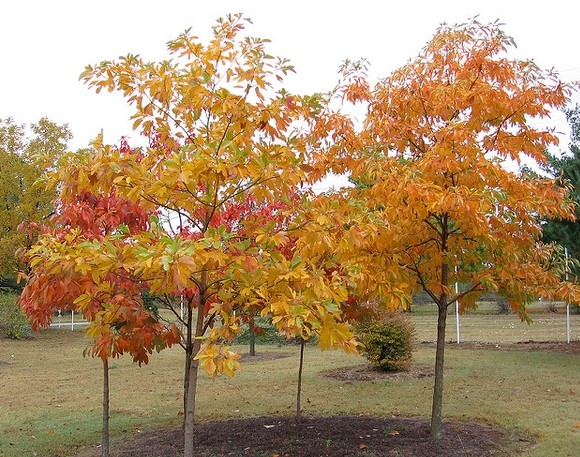
Sassafras albidum tree thicket in the fall. Photo courtesy of P.W. Hatcher and the North Carolina Extension Gardener Plant Toolbox.
Another month is over, which means it’s time for a new edition of North Carolina’s Weird and Wonderful! Over the past few years, July has become a very plant-heavy month for me, primarily due to the Cullowhee Native Plant Conference. Those who know me well can tell you that I’m not a botanist; in fact, I’m pretty sure I told my favorite biology professor in college that botany wasn’t for me. With age comes wisdom, as they say, so I’ve been trying to remedy this rather large gap in knowledge by learning from my colleagues, taking workshops and guided hikes, and, of course, purchasing and reading a lot of field guides (I know there are apps for that now. But the only way you will get me to give up my guidebooks is by prying them from my cold, dead hands). So, in honor of the Cullowhee Native Plant Conference turning over a new leaf and becoming the Southeastern Native Plant Conference, and to increase my botanical knowledge by one species, this month’s weird and wonderful focus is on the sassafras tree, Sassafras albidum.
Full disclosure: I primarily picked this tree because it is fun to say. Sassafras. What a wonderful word! It is thought that the word “sassafras” comes from the Spanish word “sasafras”, which itself may have been a word that sounded similar to a now-lost-to-time indigenous term for the plant. The sassafras tree is common throughout the Eastern United States and prefers full sun to light shade. Saplings that find themselves shaded out by larger, faster-growing plants will probably die off, but young trees that are able to get a foothold in sunny patches will begin to thrive. A large taproot makes it difficult to transplant a sassafras sapling from one spot to another, and this species has the habit of spreading via suckers to form sassafras thickets.
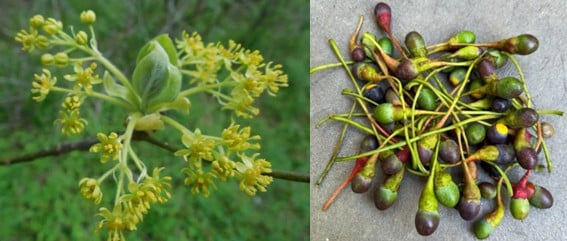
Sassafras tree flowers, left, and the ripe and unripe fruit, right. Photos courtesy of Flower of the Carolina.
In early spring, since this species is dioecious, male and female flowers appear on different trees. Fruits will only form on female trees if there were male trees (and pollinators) somewhere in the vicinity. The fragrant flowers do attract a wide variety of pollinators, including native bees, wasps, and flies, and the foliage is fodder for both the imperial moth caterpillar and the spicebush swallowtail caterpillar. Dead stems, when left standing, provide shelter in which native bees overwinter. The fruits are enjoyed by many birds and mammals, including Eastern bluebirds, wild turkeys, pileated woodpeckers, black bears, and squirrels; the bark and twigs are consumed by several mammals, with beavers, in particular, enjoying all the woody bits sassafras has to offer.
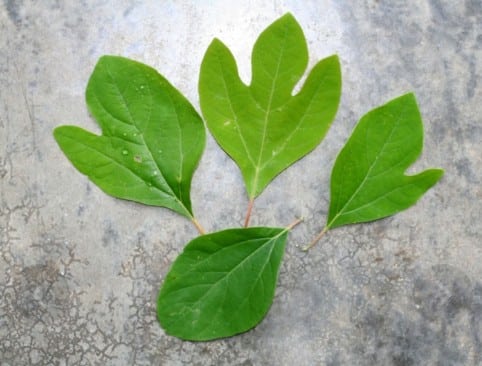
Sassafras tree leaves, demonstrating the left and right-handed mitten leaf shape, the three-fingered leaf shape, and the egg leaf shape. Photo courtesy of the Municipality of Princeton, NJ.
One of the weird and wonderful characteristics of this tree is its leaf shape. Sassafras leaves are often described as mittens, and one could say this tree is ambidextrous, as it produces both right and left-handed mittens. Other leaf shapes include a three-fingered version and a smooth egg shape. In the fall, sassafras leaves turn brilliant shades of red, orange, yellow, and even purple, often standing out amongst the rest of the fall foliage across the autumnal landscape. Mature bark is red-brown in color and was historically used to make a vibrant, orange dye for wool products.
This is where things get a bit weird. The bark, leaves, twigs, and roots of sassafras had been used for medicinal purposes for centuries. Indigenous tribes brewed teas to ease or cure numerous ailments, among them rheumatism, diarrhea, the common cold, fevers, and kidney problems. During the early years of European colonization, sassafras tea was exported out of North America in large quantities, due to the lore surrounding this tree’s extract as a cure-all wonder drug. More recently in time, safrole, the main component in sassafras oil extracted from the bark, was used as a flavoring agent for root beer, chewing gum, and as an additive in Cajun spices. Sounds pretty wonderful, right? Well, in the 1960s, researchers found that safrole, when given to mice and rats both orally and via subcutaneous injection, resulted in the development of liver tumors. As a result, safrole has been deemed a weak hepatocarcinogen for humans, and is banned by the U.S. FDA for use in food. Recent research, though, has shown that safrole has potential as an antimicrobial agent; as a potential herbal supplement for use as an antidiabetic; and as a cytotoxin used to treat cancer cells. The scientists who conducted the study, while optimistic, caution that more work is needed, especially considering the rodent study results from the middle of the 20th century.
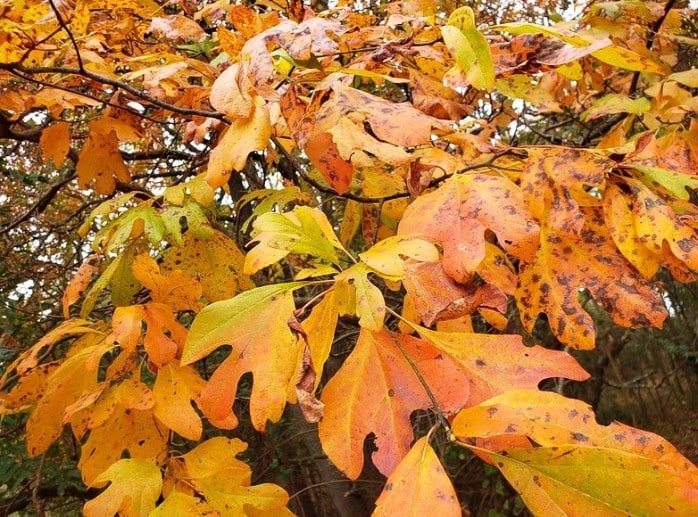
Sassafras tree in all its autumnal glory. Photo courtesy of Flower of the Carolina.
So…is safrole good or bad? It’s entirely possible that, like many other plants people assumed had healing properties throughout our past, sassafras didn’t actually contribute anything positive. It’s also plausible that the extract was able to treat some ailments, but might have also caused further illness that was never linked back to sassafras usage at the time. Perhaps whether safrole leans on the side of healing or not has to do with how the sassafras oil is collected from the tree, and then how it is subsequently treated, before being utilized as a flavoring agent or medicinal additive. Whatever the case may be, I would argue that this uncertainty adds to the weird and wonderful mystique surrounding the sassafras tree. Besides, with adorable mittens and gorgeous fall colors that can be forever preserved as a vibrant wool dye, who wouldn’t want this lovely tree in their backyard?