

Pseudacris ornata, the ornate chorus frog. Photograph courtesy of Todd Pierson and Herps of NC.
It’s time to wrap up another year and welcome a new one. Time to pack up elaborate light displays and Charles Dickens-style caroling outfits. And it is also time for another edition of North Carolina’s Weird and Wonderful. To finish up the year, and in the spirit of singing carols, I decided to focus on an amphibian: Pseudacris ornata, the ornate chorus frog. A small, plump frog that comes in colors ranging from reddish brown to green, tan, or gray, this colorful species’ calls can be heard now through March in the southern Coastal Plain of our state. While it is similar to the call of the spring peeper frog, the ornate chorus frog’s call is more metallic, rapid, and monotonic, sometimes described as a metallic “tink”.
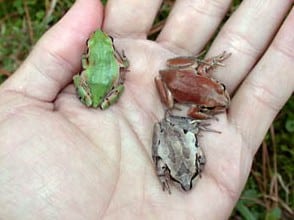
Color variations of the ornate chorus frog, Pseudacris ornata. Photograph courtesy of the University of Georgia’s Savannah River Ecology Laboratory.
This species is one that very few have seen, as they are nocturnal, and historical natural history records suggest that this species, unlike other chorus frog species, is more fossorial in nature. This means adult ornate chorus frogs spend a good portion of their time in burrows, as opposed to shrubs and trees like other frogs. This weird and wonderful habit would explain why they are hard to find when not actively engaged in breeding behavior, which primarily occurs during the winter months. Ornate chorus frogs utilize temporary ponds, vernal pools, Carolina bays, and even flooded ditches as breeding grounds in longleaf pine stands and pine savannas. Females deposit their egg clusters, which can range in size from 10 eggs to 100 eggs, on stems or other objects submerged in shallow water. The eggs hatch after 1-2 weeks, and it takes the tadpoles about 8-12 weeks to complete metamorphosis. A smaller frog species overall, the freshly metamorphosed froglets are almost the size of adult ornate chorus frogs.
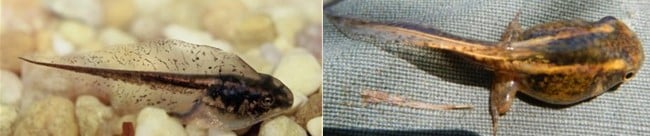
An ornate chorus frog tadpole, left, and an older ornate chorus frog tadpole, right. Left photograph courtesy of John Jensen; right photograph courtesy of Kevin Enge; and both photographs courtesy of Angela K. Burrow and Southeast PARC.
Unfortunately, the population of ornate chorus frogs in North Carolina is declining, due to the destruction of temporary wetlands, longleaf pine stands, and pine savanna habitats. This weird and wonderfully colorful frog will be at an increased risk of disappearing come 2026, when the new Waters of the U.S. rule will go into effect, as many isolated, temporary wetlands that this species use for breeding will lose federal protections. Since North Carolina does not impose environmental restrictions greater than those at the federal level, the ornate chorus frog, and many other amphibians, will need the public to champion them and work to preserve their habitats. So, if you have never seen the ornate chorus frog in the wild, but would like to in the future, make sure your local and state leaders know how important the wetland habitats of the longleaf pine stands and pine savannas are to our state’s overall biodiversity. The fate of this beautifully weird and wonderful frog may very well rest in your hands.
#NCWeirdAndWonderful #OrnateChorusFrog #NorthCarolinaWildlife #AmphibianAwareness #WetlandConservation #Biodiversity #NativeSpecies #TheSwampSchool