
The following blog post is a summary of the article “Could one of Europe’s most important wetlands really vanish? Satellites show it may happen in our lifetime” by Samantha Matthewson, published on Space.com on February 20, 2026. To read the original article, click here. To read the research paper referenced within the original article and this blog post, click here.
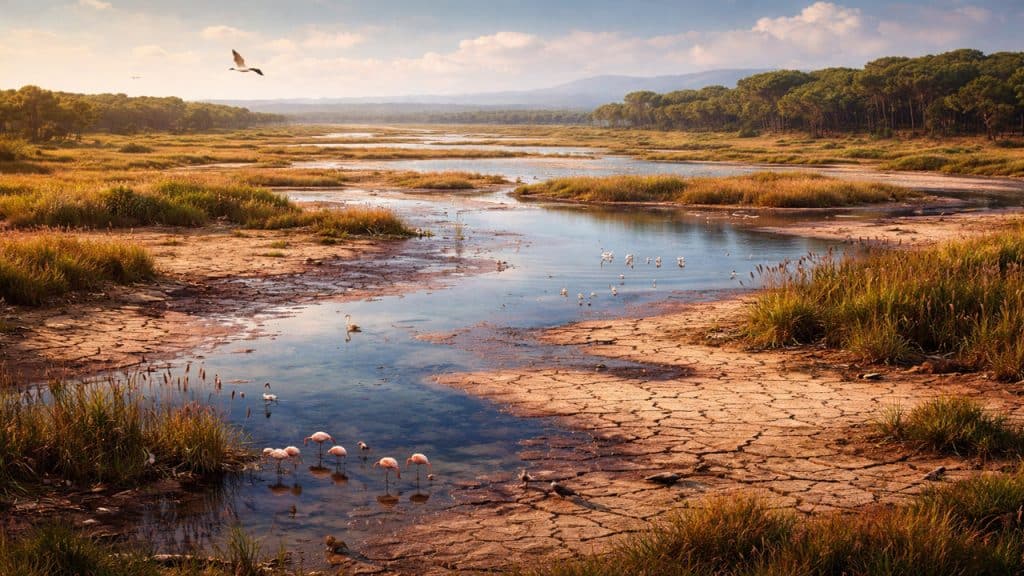
Doñana National Park in southwestern Spain is one of Europe’s most valuable wetland ecosystems, but recent satellite observations suggest it is steadily shrinking and could disappear within a human lifetime. The park plays a vital role in supporting biodiversity and serves as an important stopover and breeding site for migratory birds traveling between Europe and Africa. Researchers used high-resolution imagery from the European Space Agency’s Sentinel-2 satellites to examine changes in the marshland over time. In satellite images, the wetlands appear as patches of dark blue and violet that indicate shallow water across the floodplain. However, long-term analysis of these patterns reveals a clear decline in the park’s surface water. Scientists warn that if the current trend continues, the marsh could become effectively dry in roughly sixty years.
The research team, led by scientists from the University of Seville, combined satellite observations with machine learning methods to more accurately distinguish water from vegetation and dry soil. This approach enabled them to reconstruct how the marsh has changed over the past two decades and to model how it may evolve under future climate conditions. Their analysis shows that since 2005 the wet surface area, total water volume, and average depth of the marsh have all declined. The losses became more severe after 2010, when regional temperatures rose and rainfall decreased. Based on projected climate scenarios, the marsh could reach a critical tipping point within several decades. Depending on future climate patterns and conservation efforts, that threshold could occur in as little as forty-five years or as long as one hundred seventy-five years.
While climate change is an important driver of the marsh’s decline, human activity is also accelerating the problem. Doñana relies heavily on groundwater, yet aquifers in the surrounding region have been depleted by intensive agriculture, ineffective wastewater reuse, and the presence of illegal wells. As groundwater levels fall, less water reaches the wetland, worsening the effects of drought and rising temperatures. Even years with heavier rainfall now appear insufficient to restore the marsh to its previous condition. The consequences of losing such a system would extend far beyond southern Spain because wetlands help regulate water availability and provide critical habitat for migrating species. Researchers emphasize that stronger groundwater regulation, closing illegal wells, and improving water management could still slow or partially reverse the decline, but the satellite data provides a clear warning that Doñana’s future is increasingly uncertain.
#Wetlands #DoñanaNationalPark #NatureConservation #Biodiversity #EarthScience #WetlandWednesday #TheSwampSchool