
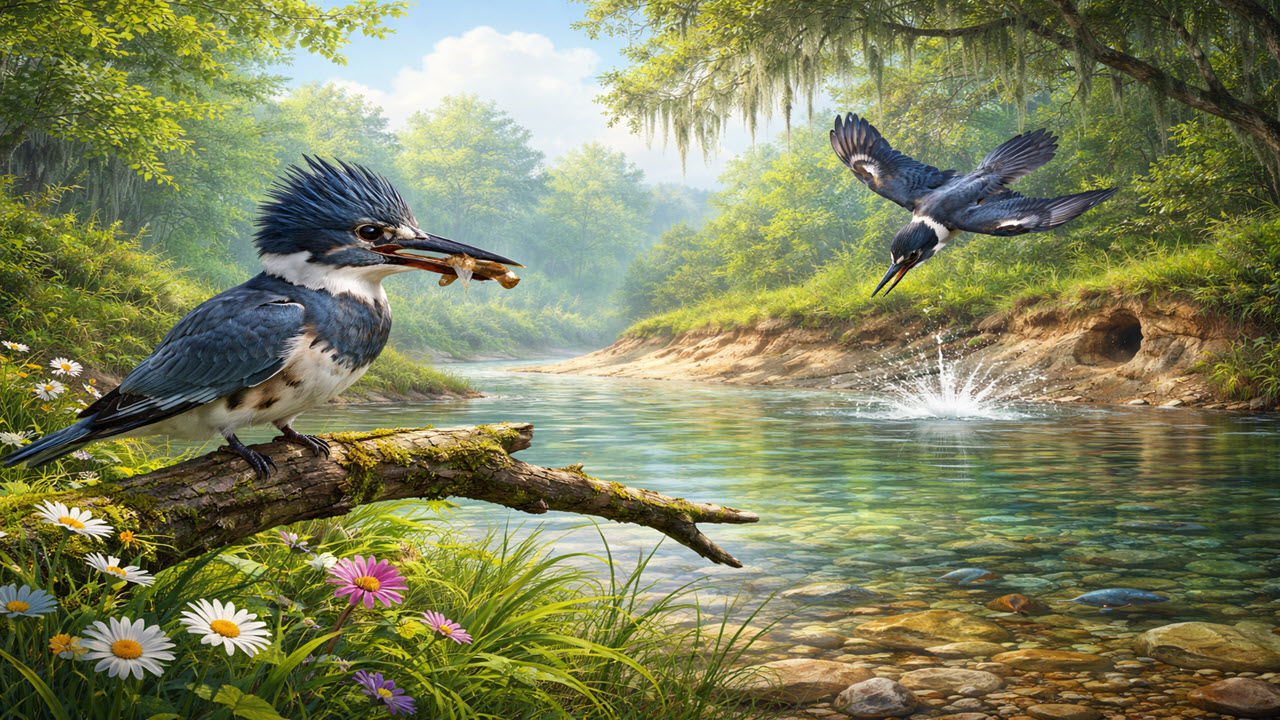
Spring has sprung here in North Carolina, which means pollen, pollen, and more pollen. Tis the time of year when everything appears as if it was swiped with a yellow highlighter. It’s also the time of year when the breeding season of this month’s weird and wonderful focus ramps up: enter the belted kingfisher, Ceryle alcyon. This visually distinctive bird can be found alongside waterbodies in our state, and while they are solitary for most of the year, they form monogamous pairs during the breeding season, which lasts from late March in warmer climates through July. Around the size of a pigeon, these birds are a powder blue color on top, with a white underbelly and blue breast band. Female belted kingfishers also have a wide, rust-colored band on their bellies. The bushy crest present on top of their large head and thick, sharp bill make this bird a recognizable sight to people enjoying our state’s lakes and rivers, though many people first realize belted kingfishers are in the area when they hear the loud, eerie rattle emitted by both males and females.
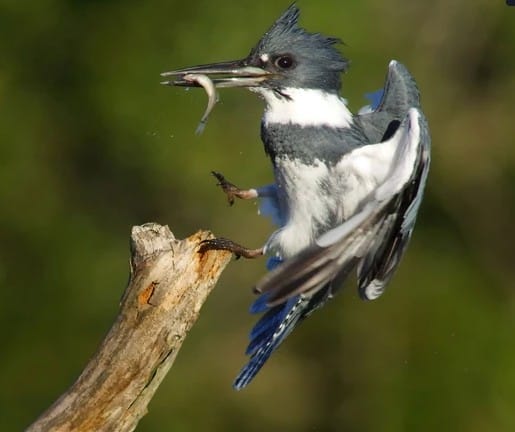
Belted kingfisher, Ceryle alcyon. Photo courtesy of Evelyn Garcia and Audubon
Belted kingfishers, as their name implies, feast on fish that they catch in clear bodies of water. The water needs to be clear so they can see the fish from above; once they have spotted a fish near the surface, they dive, eyes fully closed, and grab it with their bill. Upon returning to their perch with their meal, they bash it against the perch before swallowing it head first. These birds have also been known to hover over the surface of the water, searching for prey, before quickly diving down to catch their prize. Fish are not the only item on the menu: belted kingfishers also eat crayfish, amphibians, reptiles, young birds, insects, mollusks, and even small mammals. Essentially, if they can swallow it, they will catch it and eat it. The skeletons, mollusk shells, insect exoskeletons, and other indigestible pieces are later regurgitated as pellets, similar to the pellets of owls and other large birds of prey.
Individual belted kingfishers will establish territories that run parallel to the shoreline of lakes, rivers, and large streams. When an intruder is spotted, a belted kingfisher may fly back and forth across the water while emitting their trademark rattling call, or they may land on a nearby perch and bob their body up and down while elevating their crest to scare them off. When breeding season begins, males and females cease being solitary and form monogamous pairings; however, these pairings do not last beyond a single mating season. When the next breeding season rolls around, they will find different mates. As part of the courtship process, a male belted kingfisher will present a fish he has caught to a female who has landed nearby, and she may eat the fish he presents.
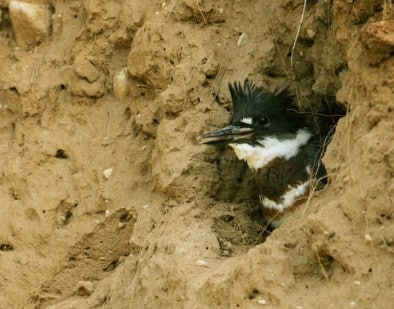
Female belted kingfisher emerging from her burrow. Photo courtesy of Jack Bartholmai and Kickapoo Valley Reserve
One of the weird and wonderful traits of this species is that they do not nest in trees. Instead, they nest in burrows! Both the male and female take turns excavating a tunnel that stretches from 3-6 feet long. It is during this task that their thick, sturdy bill comes in handy as a digging tool. Belted kingfishers need vertical banks in which to dig their tunnels, which is why some water bodies without tall vertical banks may have several kingfishers that feed there, but do not nest there. The tunnels slope upwards to prevent rainwater from pooling inside, and throughout the incubation process, the undigested skeletal remains, mollusk shells, and other refuse regurgitated by the parents provide some insulation. The eggs are pure white and glossy, and a female will lay a clutch ranging from 5-8 eggs. After about 24 days, the eggs hatch, and both parents feed the chicks, starting off their diet with partially digested fish but progressing to whole fish by the time the chicks leave the nest a month later. Belted kingfisher chicks have their own weirdly wonderful trait: their stomach contents are highly acidic, which allows them to digest bones, scales, shells, and other typically indigestible bits until they are ready to leave the nest. Following their departure, their parents will continue to feed them for about three weeks. Due to the warmer climate, belted kingfishers in North Carolina may be able to raise two broods each year. Once their young have grown up and left to establish their own territories, their parents will split and return to their solitary lifestyle.
Once hunted to prevent them from eating fish in hatcheries and trout streams, belted kingfisher populations today are steady, and the species is of low conservation concern. They are sensitive to site disturbance, though, and may abandon their territories if there is too much human activity in the direct vicinity. So, if you are feeling like braving the pollen dust storm and accompanying allergies to visit one of our state’s beautiful lakes, rivers, and streams this spring, you might be fortunate enough to watch a belted kingfisher flitting about the banks and water, hunting for prey. These carnivorous birds are truly a weirdly wonderful sight to behold.
#BeltedKingfisher #NCWildlife #NorthCarolinaWeirdandWonderful #WetlandWednesday #TheSwampSchool