
The following blog post is a summary of the article, “Earth’s storage of water in soil, lakes and rivers is dwindling. And it’s especially bad for farming” by Melina Walling, published in the Associated Press on March 27, 2025. To read the original article, click here.
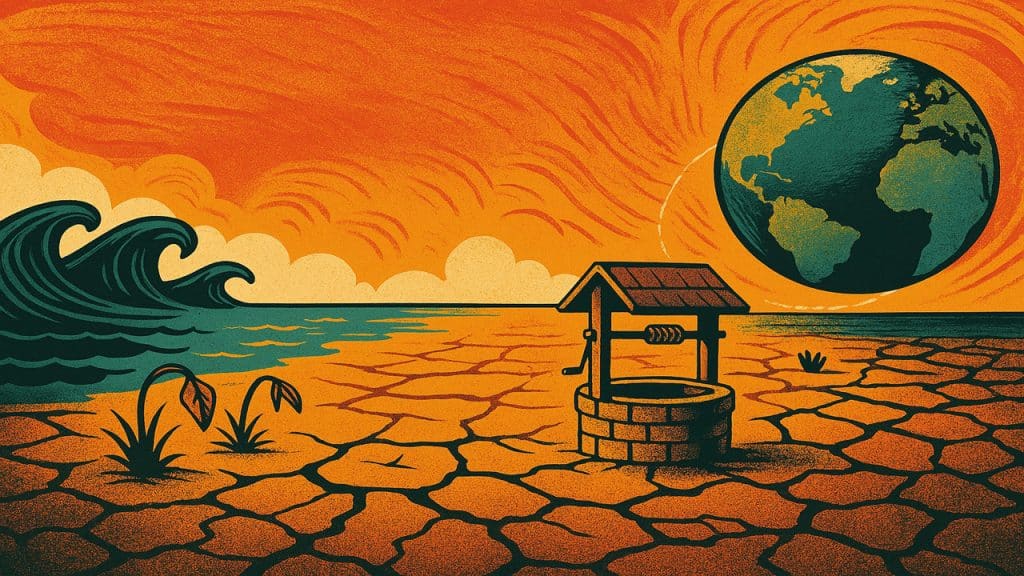
Hydrology professor Dongryeol Ryu of the University of Melbourne and his collaborator Ki-Weon Seo discovered a troubling trend while reviewing data during a train ride: Earth has lost a staggering amount of water stored on land. Initially dismissing the result as a model error, they spent a year validating their findings, which were ultimately published in Science. Their research reveals that global warming has drastically reduced the water stored in soil, lakes, rivers, and snow, with Earth losing over 2,000 gigatons of soil moisture in just two decades—more than double Greenland’s ice loss in a comparable period. This depletion has serious consequences, including increased frequency of extreme droughts, rising sea levels, and even a measurable shift in the Earth’s pole. The data, confirmed using three different sources, suggests that the land may have lost its ability to recover its former water storage capacity, despite dramatic rainfall events following droughts.
Whether this loss of elasticity can be reversed depends largely on human actions regarding climate change and water consumption. Rising temperatures increase plants’ water demands, while irrigation and other agricultural practices continue to deplete resources unsustainably. The continued emission of greenhouse gases without meaningful mitigation efforts further exacerbates the problem. According to scientists like Katharine Jacobs, long-term climatic shifts might eventually reverse the trend, but likely not within our lifetimes. The study also sheds light on a subtle wobble in Earth’s rotation, now linked to changes in land moisture. Hydrologist Luis Samaniego, who commented on the research, likened this wobble to an Earth-scale arrhythmia—an urgent signal we risk ignoring at our peril.