
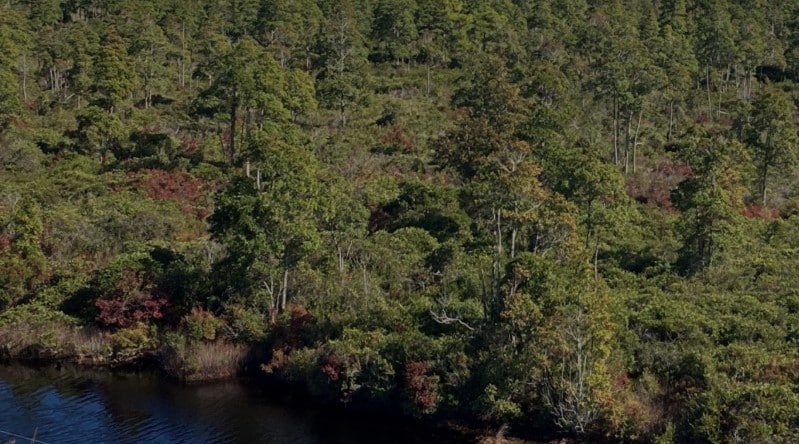
When people think of peat bogs, their minds might head to Europe, to the bogs of the British Isles, famous for their “bog bodies“. Or perhaps they might think of the boreal peat bogs of the frozen north; but many probably do not think of the peatlands present along the Eastern Seaboard of the United States. In North Carolina, the race is on to preserve and protect the state’s remaining peat bogs before they dry up or worse, catch fire and burn out of control. Accounting for only about 3% of the Earth’s surface, peatlands are responsible for storing one-third of the carbon dioxide on our planet. When degraded, destroyed, or burned, huge amounts of greenhouse gases are released. The protection and restoration project in the Inner Banks of North Carolina is being undertaken with the ultimate goal of selling carbon credits to corporations that want to offset their own greenhouse gas emissions.
Adjacent to the Pocosin Lakes National Wildlife Refuge, where peatland restoration efforts have been underway for several years, the latest peat bog project is led by Pantheon Regeneration and guided by scientists with Duke University. Domed peatland is comprised of organic matter from coastal pine forests and evergreen shrubbery that has decayed over millennia and is known as Pocosin peat. Found only along the Eastern Seaboard, Pocosin peat ecosystems are under threat, primarily from habitat destruction at the hands of humans and sometimes even Mother Nature herself. In 2008, a lightning strike in the eastern portion of the Pocosin Lakes National Wildlife Refuge started a wildfire that burned for three months above ground. Belowground, the peat continued to burn for four more months, resulting in the ground lowering by a foot and a half in some places. In areas of the refuge that had already undergone some hydrology restoration, the fires burned with less intensity, as the peat was moister in those spots.
Pantheon Regeneration selected the current project site because they feel that the urgency now is to restore degraded peatlands before they are completely destroyed. The plan is to block off drainage ditches and canals that had originally been constructed to drain the peat and make it into suitable farmland. In blocking off those ditches, the water level can be restored, bringing water back to the peatland, staving off wildfire disaster, and creating habitat for wildlife that will, hopefully one day, become a biodiversity hotspot like the neighboring Pocosin Lakes National Wildlife Refuge.
By selling carbon credits from this restored peatland, Pantheon Regeneration hopes to use those funds to purchase more degraded peatland for restoration as well as peatland that is still relatively well-preserved. While the concept of carbon credits, where corporations invest in projects such as peatland restoration and preservation to offset their own greenhouse gas emissions, is controversial, Pantheon is taking a more scientific approach, using decades of data collected by Duke University researchers Dr. Curtis Richardson and Dr. Neal Flanagan and the Duke University Wetland and Coasts Center to ensure that accurate levels of how much carbon is being captured and stored are used to determine the credits. Perhaps this project will inspire others to learn more about the unique peat bog habitat that calls North Carolina home, and to strive to restore and protect it.
#NorthCarolina #Peatlands #WetlandRestoration #Conservation #Wetlands #PocosinNationalWildlifeRefuge #WetlandWednesday #TheSwampSchool