
The following blog post is a summary of the article “Floating wetlands bring back Boston’s natural landscape lost to development” by Bianca Garcia, published by the NPR Boston affiliate WBUR on May 20, 2026. To read the original article and listen to the radio program, click here.

The newly constructed floating wetland in Boston’s Fort Point Channel. Photograph courtesy of Robin Lubbock and WBUR.
Boston’s Fort Point Channel is now home to a newly constructed floating wetland that appeared in less than a week through a collaboration between Save the Harbor/Save the Bay, the real estate development firm Alexandria, and the Scottish company Biomatrix Water. The 1,400-square-foot structure was built from recycled pipes, stainless steel, compost, and native plants, creating what its designers describe as a giant floating planting basket. Although it currently resembles a muddy raft with sparse vegetation, the project is intended to develop into a thriving habitat for local wildlife. Salt-tolerant New England plants have already been installed, and organizers expect mussels, clams, sponges, fish, and zooplankton to gradually populate the ecosystem. Supporters hope the project will encourage greater public interest in Boston’s waterfront while demonstrating new approaches to environmental restoration.
The floating wetland is designed to recreate “edge habitat,” the natural transition zone between land and water that largely disappeared when Boston’s shoreline was reshaped by landfill and seawalls. Historically, these wetlands provided important ecological services by supporting wildlife, reducing flooding, and filtering pollutants from the water. Restoring similar environments has become increasingly important as climate change contributes to rising sea levels, stronger storms, and ecosystem disruptions. The Fort Point venture is one of more than 200 floating wetlands Biomatrix has installed worldwide, though this particular project is notable because it must withstand the challenges of a saltwater environment. Project leaders view it as a practical example of how urban areas can reintroduce natural systems into heavily developed landscapes.
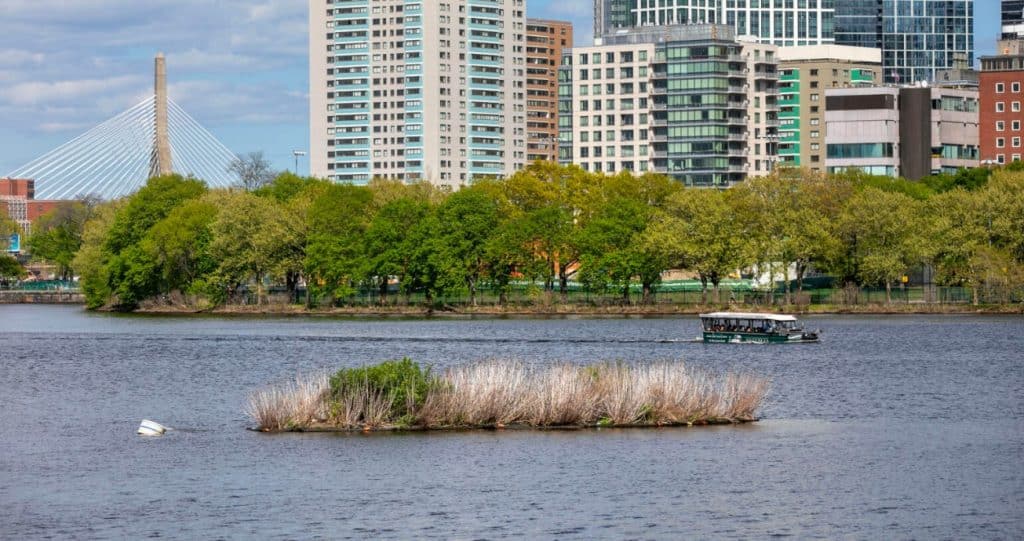
The Charles River Conservancy’s floating wetland. Photograph courtesy of Robin Lubbock and WBUR.
The effort builds on lessons learned from a floating wetland that has operated seasonally in the Charles River since 2020. Research conducted there found that algae-eating zooplankton were more abundant among the wetland’s underwater roots, suggesting that such installations can provide valuable habitat and potentially help absorb excess nutrients. While experts agree that floating wetlands alone cannot solve major water quality problems, they believe these projects can deliver localized environmental benefits and contribute to broader restoration efforts. Future plans include expanding floating wetland networks in Boston through projects in Broad Canal and near the Museum of Science. Organizers expect the Fort Point Channel wetland to become much more vibrant by next summer as plants spread, wildlife settles in, and birds begin using the area for nesting.
#FloatingWetland #Boston #UrbanNature #WildlifeHabitat #GreenInfrastructure #NatureBasedSolutions #BiomatrixWater #SavetheHarborSavetheBay #WetlandWednesday #TheSwampSchool