
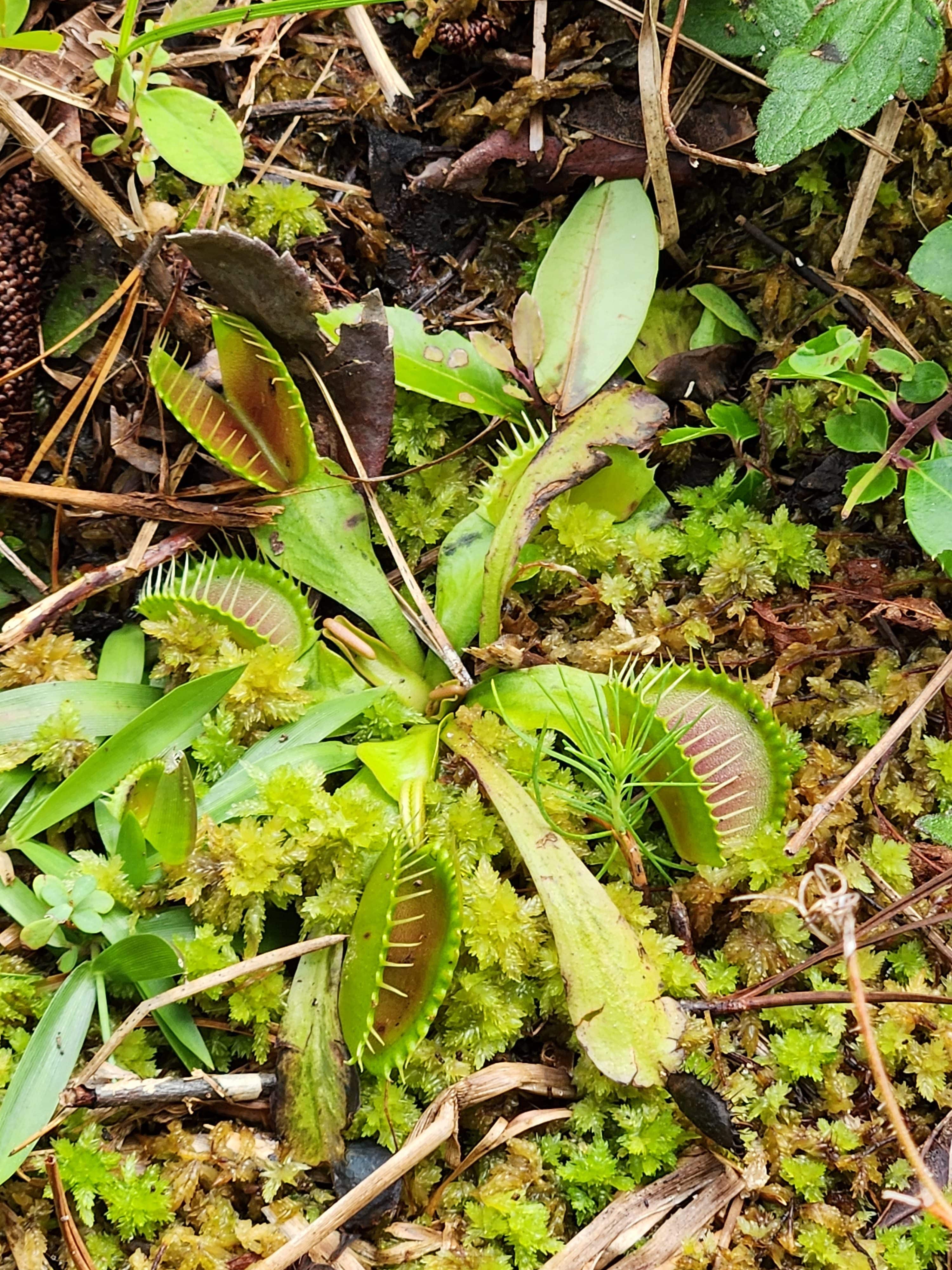
It’s Halloween Eve, which means it’s time for another Halloween edition of North Carolina’s Weird and Wonderful! In years past, I have celebrated the two-toed amphiuma alongside the then-seventy-years old horror classic, The Creature from the Black Lagoon, which I thought was a particularly clever combo. Last year I profiled the jack-o-lantern mushroom, a glowing treasure in North Carolina’s forests. This year, I have decided to take inspiration from another classic film celebrating a big anniversary, its 40th, Little Shop of Horrors, and the plant species that inspired the most important character, Audrey II: the Venus fly trap, Dionaea muscipula.
Venus fly traps are only found in a small coastal region of southeastern North Carolina and northeastern South Carolina, in a radius of around 60-100 miles around Wilmington, North Carolina, growing in wet savannas and sandhill seepages. The soils tend to be sandy and acidic, and the overall habitat is greatly influenced by fire. The fly traps themselves require high-light conditions, with wildfires keeping the savannas and seepages from getting too overgrown with shrubs and trees that would block out the light and crowd out the fly traps. While indigenous communities were undoubtedly aware of the fly traps’ existence, the western scientific community was first introduced to them in 1759, when North Carolina colonial Governor Arthur Dobbs wrote about them in his diary. A few years later in 1768 live specimens were transported across the pond to England by royal botanist William Young. He collected his specimens in Brunswick County, North Carolina, and they ended up in London, where members of the Royal Society took a keen interest. One member, John Ellis, ended up writing about the botanical curiosity in a letter to Carolus Linneaus himself.
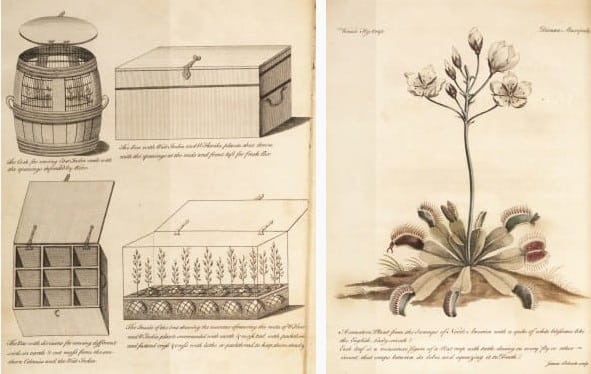
Illustrations from John Ellis’ 1770 publication Directions for bringing over seeds and plants, from the East-Indies and other distance countries, in a state of vegetation. Within this treatise he included a description for a recently discovered plant species from the New World: the Venus fly-trap. Illustration courtesy of the Royal College of Surgeons of England.
Now, unlike the imposing Audrey II, the Venus fly trap is actually a very small plant consisting of a rosette of leaves that are usually fully reclined, or at least partially reclined, with the trap portion sitting at 45°-60° angles when undisturbed. The “stem” is a rhizome, and is fully below ground with the rest of the fibrous root system. The leaves consist of two parts: a broad petiole, which resembles a leaf-like stem, that radiates outward from the center of the plant; and a leaf blade that consists of two clamshell-like halves, which comprises the trap portion, at the very end of the leaf. The adaxial, aka upper, surface of the trap is often pinkish or reddish in color, which is thought to attract insects and get them to land, though this surface in many traps can range in color from pale green and yellow to deep red. The pressure of an insect landing on the adaxial surface triggers the two clamshell halves to quickly shut, turning into a clam-shaped claw with the food item trapped inside. Once they have snapped shut around a bug, the traps will remain sealed shut for 5-7 days while digestion takes place. After the food has been fully digested, the trap will open again, and will be ready to catch another morsel. Sometimes you can even see the dried out, chitinous exoskeletons left behind in a trap after digestion is complete, which is pretty weird and wonderful, if you ask me. Each trap is capable of capturing and digesting prey up to three times, after which the trap loses its eating ability. If a trap captures a very large prey item, that will bring about the demise of that particular leaf; new leaves, and subsequently, new traps, are continuously produced throughout the growing season. In addition to capturing and eating insects and arachnids, Venus fly traps also photosynthesize like their non-carnivorous plant neighbors. The nutrients gained from the unfortunate little bugs and spiders that find themselves ensnared help make up for the poor nutrient content in the soil in their native habitat.
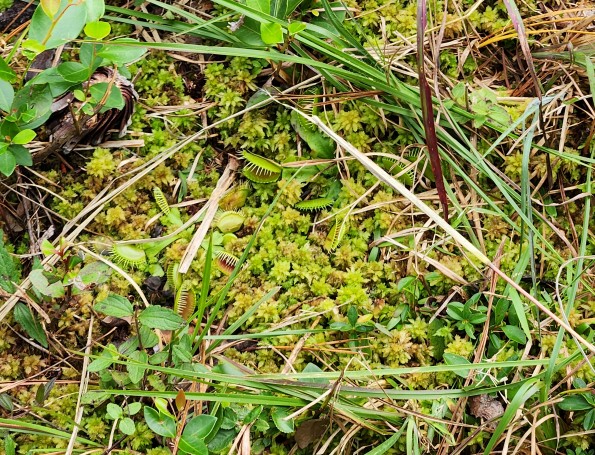
Dionaea muscipula, the Venus fly trap, nestled in its native habitat in Carolina Beach State Park, New Hanover County, North Carolina. Photograph courtesy of the author.
So, how exactly do the leaves shut so quickly? Time for some weird and wonderful science! There have been many hypotheses proposed, since the time of Charles Darwin, on how Venus fly traps actually work. If the leaves take too long to close, the plant risks the prey item escaping before it can be captured and digested. Older theories from Darwin’s time suggested that the fly traps might contain muscles or nerves, like animals. That idea has since been debunked. What is known for sure is that there are three highly sensitive trigger hairs present on each lobe of the leaf, and when mechanically stimulated, the lobes will close together in 0.3 seconds. A study published in 2008 in Plant Physiology discovered that touching the trigger hairs activates mechanosensitive ion channels in the plant cells, which induce action potentials within those cells. As a result of that action potential, which is a change in voltage across the cell due to the movement of positive ions across the cell membrane, the cells within the two lobes change in shape, curvature, and volume. These changes result in the rapid closure of the two lobes together. More recently, a study published in Science found that cell walls within the two lobes softened when the trigger hairs were activated, with the researchers hypothesizing that this action releases stored stress and causes the lobes to bend and close. Other researchers hypothesize that it is the movement of water into and out of the cells within the lobes that causes the trap to shut so quickly. What is clear is that more research still needs to happen to understand how these weirdly wonderful plants are able to trap their prey.
Dionaea muscipula, the Venus fly trap, in its native habitat in Carolina Beach State Park, New Hanover County, North Carolina. Photograph courtesy of the author.
Some of the energy gained through eating insects is used to produce the flower, which is a white, five-petaled, and cluster-like and is perched on top of a single stalk that emerges from May and remains through June. If you visit Carolina Beach State Park or Green Swamp Preserve in North Carolina, or the Lewis Ocean Bay Heritage Preserve in South Carolina during those months, you might get luck and see the Venus fly trap in full bloom. Tiny beetles and sweat bees are the primary pollinators, with tiny, black, pear-shaped seeds resulting from successful pollination. These seeds will automatically begin to germinate if dispersed on suitable substrate, and it takes about 3-4 years for a plant to mature. It is estimated that the plants can survive for a quarter of a century if they are in suitable habitat and are not influenced by stressors.
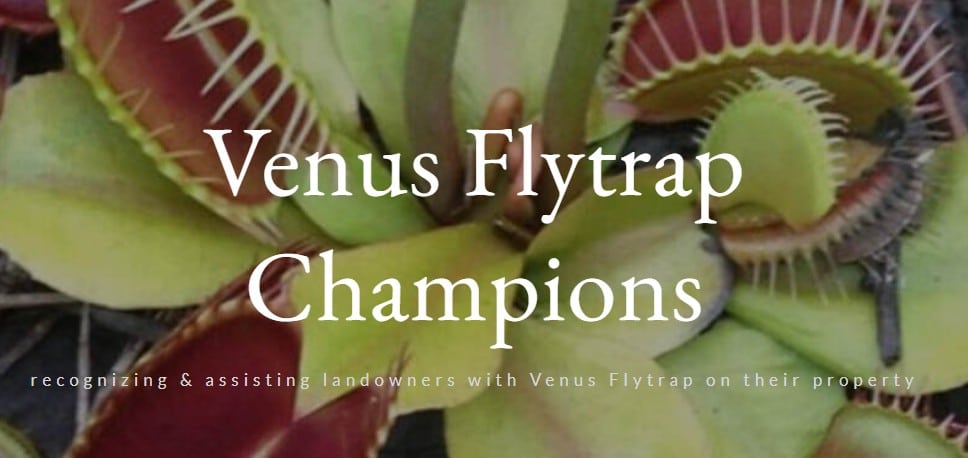
Unfortunately, stressors appear to be all around, in the form of habitat destruction, habitat degradation, and poaching. As urban and suburban sprawl continues, more savanna and sandhill seep habitats are under threat of being outright destroyed for development, or degraded due to nearby development and environmental stressors, including longer droughts, longer periods of time without wildfire, and more intense fires when they do occur. In addition, humans have always been fascinated with Venus fly traps, and many people unfortunately collect them illegally from the wild to add to their personal collection and to propagate and sell to other carnivorous plant enthusiasts. But all is not lost! The Venus Fly Trap Champions is a group based in North Carolina that seeks to protect Venus fly trap habitat, when possible, by helping landowners when they find them on their property and by relocating wild populations to safer locations when staying put is not an option. Together with their partners, which include the North Carolina Botanical Garden, the North Carolina Wildlife Resources Commission, and the U.S. Fish and Wildlife Service, among others, their mission is to educate the public about these awesome plants in their backyard, protect and restore prime habitat, locate previously unknown populations, and move Venus fly traps to safer areas in order to keep those genetics in play. The hope is that there will always be sustainable wild populations of Venus fly traps in the Carolinas, and that more people will work towards protecting them and their habitat for years to come. So, this Halloween, as you sit back to celebrate forty years of a carnivorous plant with a penchant for people, take a moment to also celebrate the charismatic Venus fly trap. This weird and wonderful botanical curiosity needs all the thoughts, prayers, musical numbers, and help it can get.