

Blarina brevicauda, the Northern Short-tailed Shrew. Photograph courtesy of Jim Petranka and Mammals of North Carolina.
North Carolina is home to many weird and wonderful mammalian species, two of which have already been discussed in past issues of this blog. This month’s focus is on two small, unobtrusive species: the short-tailed shrews. North Carolina is home to both the Northern and the Southern species, and while there are physical traits that can distinguish them from each other, many individuals can only be identified by experts in shrew morphology. Both of these shrews are members of the Blarina genus, and both are relatively large, with tiny eyes, and reduced ears that are hidden by their thick, velvety fur. Their namesake comes from the fact that they have short tails that are around one-third the length of the head and body. Northern short-tailed shrews, Blarina brevicauda, tend to be larger on average than their Southern cousins, Blarina carolinensis; they also tend to be lighter in color. These two species overlap in the tidewater regions of our state, but elsewhere, the Northern type resides in the western mountains, while the Southern type lives in the piedmont and coastal plain.

Short-tailed shrew skull.
These shrews prefer to tunnel under leaf litter in most terrestrial environments, including forests, salt marshes, and fields. They also utilize runways, or paths, on the surface, which are also frequented by mice, voles, and other shrew species. As a result, they are seldom seen unless a housecat catches and presents one to their humans. Short-tailed shrews communicate with each other through clicks, squeaks, and even echolocation! That’s a pretty weird and wonderful skill all on its own, but these two shrew species also communicate using a strong odor that they produce in glands near each hip. This odor becomes more potent during breeding season, when it is used to signal reproductive status, but throughout the year the odor communicates each individual shrew’s territorial boundaries. Short-tailed shrews are prolific breeders, with females giving birth to three to four litters every year from February through November. The nests are constructed of dried grasses and shredded leaves and are usually placed under tree stumps and fallen logs. Baby shrews are born pink and hairless, but they are weaned at about three weeks of age.
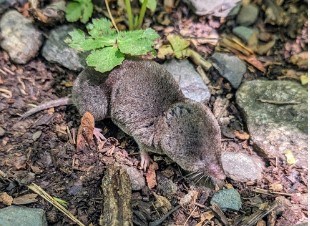
Blarina brevicauda, Northern Short-tailed Shrew
Alright, now onto the really weird and wonderful trait about these little critters! Short-tailed shrews, and all shrew species, are insectivores, meaning they feed on insects and other small invertebrates. While they do not directly impact humans, and for the most part we do not directly impact them, shrews are beneficial because they provide insect control. Spiders, beetles, worms, grubs, snails, and even the occasional small vertebrate make up their diet. Short-tailed shrews, due to their high metabolism, must consume the equivalent of their body weight every day. That’s a lot of arthropods to catch and eat, but that process is made easier through the use of their venom. Yes, that’s right. Short-tailed shrews are venomous mammals! Unlike venomous snakes, which have hollow, hypodermic-like fangs to inject venom into their prey, short-tailed shrews’ have a groove on each of their bottom incisors. The venom flows down the groove and enters the prey through the bite wound; the shrews must bite and chew to really get the venom flowing into their prey. It has been hypothesized that a single shrew has enough venom in its tiny body to kill 200 mice at any given time. Usually, though, the short-tailed shrews either kill their prey, or paralyze it and stash it away for later. The next time you see something rustling under the leaf litter, remember that it could very well be one of these furry, tiny, venomous, weird and wonderful predators on the hunt for their next meal.