
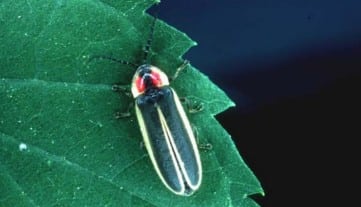
Adult male pointy-lobed firefly, Photinus acuminatus. Photo courtesy of James E. Lloyd and the Xerces Society.
Well, it’s the end of June, which means summer is finally here! And nothing screams summer more than chasing fireflies across the yard at dusk. North Carolina is a really special state because we have over forty species of lightning bugs! Of course, both of those names are misnomers, because fireflies are not actually flies, and lightning is not involved in their lovely glow. These insects are actually beetles, but while most beetles typically have a hard exoskeleton, lightning bugs are soft-bodied beetles, and thus are more sensitive to both drying out and succumbing to pesticides. While the most common firefly in our state is probably the common eastern firefly, also known as the Big Dipper Firefly, this month’s weird and wonderful focus is going to be on a far lesser known relative: the Pointy-Lobed Firefly, Photinus acuminatus.
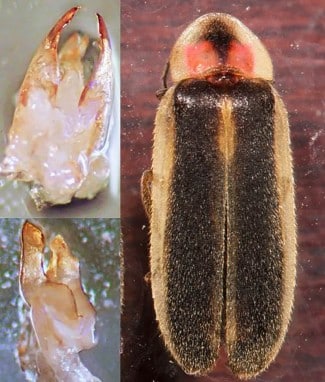
Adult male pointy-lobed firefly, right, collected in southern Ohio in 2019. The pointy lobes on its aedeagus, left, confirmed this specimen to be a pointy-lobed firefly. Photograph courtesy of Laura S. Hughes and the Ohio Biological Survey, Inc.
The pointy-lobed firefly is an incredibly rare insect, not only in North Carolina, but across its historic range in the Southeastern United States. This species was originally described in the 1950s from a single male specimen collected in the Pisgah region of North Carolina and a single female specimen collected from Florida. Similar in appearance to the little gray firefly, Photinus marginellus, the pointy-lobed firefly has dark elytra (the hard outer wings of beetles) with a pale, wide outer border. The dark central marking on the dorsal (top) side of their pronotum, which is the hard, protective sclerite that covers and protects the insect’s head and first thoracic segment, reaches the pronotum’s base. This dark marking has two red or pink spots on either side. In living specimens, these spots tend to be a deeper red, and the pale, wide border of the elytra are a brighter, light yellow in color. The name pointy-lobe comes from the lateral lobes on male pointy-lobe fireflies’ aedeagus, aka genitalia. In fact, the examination of the male genitalia is required for accurately identifying whether a specimen is a member of this species or not. That sounds pretty weird to me!
Pointy-lobed fireflies, like their more common cousins, are bioluminescent. Within their abdomen is a special organ called a photophore, and it is within that organ that a chemical reaction producing light takes place. Fireflies combine oxygen with the chemical luciferin in the presence of the luciferase enzymes, and this reaction results in light production. Pointy-lobed fireflies emit their flashes of light from June-July. The males have a flash pattern of a single, bright flash that lasts about 100 milliseconds. These short flashes are emitted at about 2 second periods, with females issuing a short response flash at around a 300-millisecond delay. The larvae of all members of the Lampyridae family, which is the insect group that contains all firefly species, are predaceous, so entomologists assume that pointy-lobed larvae are as well, in addition to being bioluminescent. Larvae of species in the Photinus genus tend to be subterranean (meaning they live underground) and specialize in eating earthworms. How weird and wonderful is that?
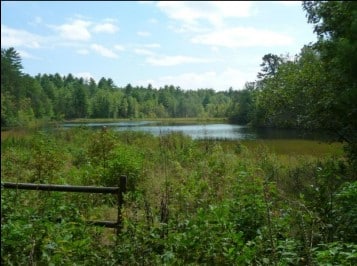
Shrubby wetland habitat in upstate South Carolina where the pointy-lobed firefly has been documented in the past. Photograph courtesy of Richard Joyce and the Xerces Society.
Little is known about the specifics of this species’ life history, as most of the recorded localities are known only from single collected specimens captured at each spot. Within the past twenty years, living pointy-lobed fireflies have only been documented at a single site in South Carolina and a single site in Ohio. However, entomologists suspect there are small populations throughout the southeast, with the historic range potentially spreading into the Midwest. One of the wonderful traits of the pointy-lobed firefly is that it appears to live in shrubby wetland habitats, such as bogs, fens, and swamps. All the more reason to conserve these habitats, in my book! Unfortunately, as these habitats are filled in and destroyed to make way for more housing and commercial developments, the already tiny populations of the pointy-lobed firefly are at an increased risk of completely disappearing.
In addition, as alluded to at the beginning of this blog, fireflies are even more susceptible to pesticides than other insects, including pesticides that are used to target nuisance or invasive species. While pesticides tend to be sprayed above ground, they can soak into the soil, affecting the larval form of the pointy-lobed firefly. Pesticides applied to alfalfa and other grasses raised for livestock end up in the manure, which, if applied to pastures, meadows, and yards as compost, can poison the soil and eliminate the existing firefly population. Finally, light pollution disrupts the mating displays of the males and the responses of the females, making it harder for two to find each other and mate. Keeping porch lights and other outside lights turned off from dusk until dawn is the best way to prevent light pollution around your home, but you can also swap out your existing bulbs for yellow bulbs, as that wavelength falls along the edge of light wavelengths that insects can discern. Some yellow bulbs even come with a “bug light” label, helping you figure out which one is best, and LED bulbs, being more energy efficient than incandescent bulbs, are the way to go.
Landing page for the Xerces Society’s Firefly Atlas website. Courtesy of Firefly Atlas and the Xerces Society.
If the plight of the pointy-lobed firefly, and all firefly species, has inspired you to learn more, check out the Xerces Society for Invertebrate Conservation. This organization is dedicated to educating people about invertebrates’ role in the natural world and conserving crucial habitat for threatened and endangered species. To figure out where the pointy-lobed firefly and other rare, threatened, and endangered firefly species are, the Xerces Society has created a Firefly Atlas. This is a citizen science project aimed at tracking and conserving threatened firefly species in North America. The hope is that more data will enable critical habitats to become identified and protected. So, as dusk approaches and your backyard fireflies emerge, think of the pointy-lobed firefly, trying its best to hang on in ever-shrinking wetland habitat in an increasingly illuminated world.
#PointyLobedFirefly #Lightningbug #Fireflies #FireflyConservation #FireflyAtlas #XercesSociety #NorthCarolinasWeirdandWonderful #WetlandWednesday #TheSwampSchool