

It’s that time of the month again! The time to learn about one of North Carolina’s weird and wonderful plants and animals. For this go around, I decided to focus on a pair of North Carolina species: the pipevine and the pipevine swallowtail butterfly. You cannot really talk about the pipevine plant without talking about the butterfly whose caterpillars feed almost exclusively on it. Pipevine, Aristolochia macrophylla, is also known as Dutchman’s Pipe, as the flowers resemble the smoking pipes of old. A woody vine with large, heart-shaped leaves, the pipe-like flowers keep a low profile and are brownish-purple in color. These flowers are out through May and June and are primarily pollinated by small flies. Flies are drawn to the flowers by their scent, which varies from species to species of pipevine but often resembles feces, carrion, or fungi. Once inside the flower, they are trapped by the large anthers, and are unable to escape until the anthers burst, scattering their pollen grains onto the insect. The fly, once able to make its escape, leaves covered in pollen but, lured back to another flower by the same odor, cross-pollinates it. This trap-and-release process is a pretty weird and wonderful method of pollination, but it is not the only trick to survival that pipevine has up its sleeve. The leaves are full of aristolochic acids, which are carcinogenic, nephrotoxic, and mutagenic. In essence, these toxins increase the risk of cancer, cause severe kidney damage, and result in DNA damage by mutating your DNA. As a result, most animals do not munch on this plant, aside from the caterpillar stage of one butterfly: the pipevine swallowtail.
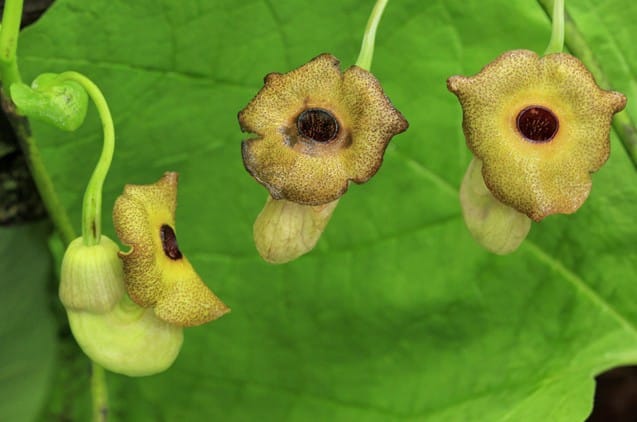
Dutchman’s Pipe Pipevine, Aristolochia macrophylla. Photograph courtesy of Alan Cressler and Lady Bird Johnson Wildflower Center.
The pipevine swallowtail, Battus philenor, is found throughout the Southeastern United States. A beautiful insect, with much of the hindwing a shimmering blue, their larval form is quite the spectacle to behold. The pipevine swallowtail caterpillar is usually a dull or dusky black, with fleshy projections that extend from the body. Most caterpillars have reddish-orange warts on their dorsal (back) side; their resemblance to velvet worms is uncanny and may help them avoid predation. Velvet worms are an invertebrate group that feed on other invertebrates by launching strings of slime from a gland on their head and engulfing their prey with slime. Don’t worry, pipevine swallowtail caterpillars are not shooting slime at other critters in your backyard (though how weird and wonderfully cool would that be?!); but if you have a pipevine plant, they will be chomping away on the leaves. They use the aristolochic acids as a defense mechanism: if their looks do not scare you off, their taste will! These chemical compounds, while toxic to humans and most other animals, are utilized by the adult butterflies as well: they can detect their odor, which helps guide them to which plants are suitable for them to deposit their eggs. Beginning in June, you can spot the caterpillars on pipevine plants, and they overwinter in their chrysalis form. You can often find chrysalises attached to pipevine plants throughout the fall and winter. Let them be, and the beautiful adult forms will emerge in the spring.
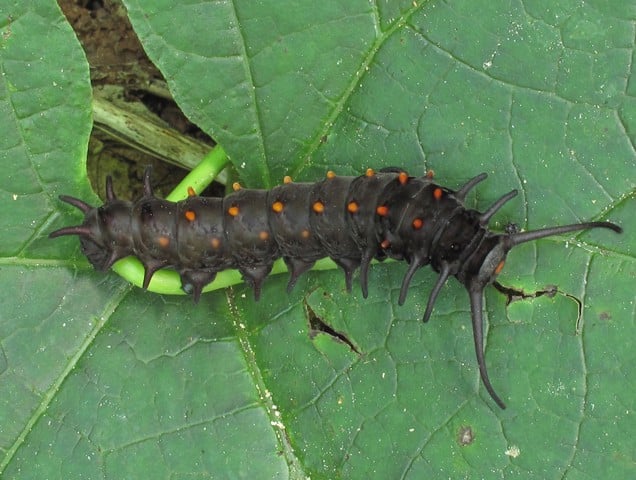
Pipevine Swallowtail, Battus philenor, in the caterpillar form. Photograph courtesy of Alan Cressler and Lady Bird Johnson Wildflower Center.
If you are interested in experiencing this weird and wonderful combo, you are in luck! Many native plant nurseries in North Carolina carry Aristolochia macrophylla, so you can add this flowering vine to your home landscape. Plant it in partial shade in rich, moist soil, then sit back and wait for the pipevine swallowtail butterflies to arrive! The caterpillars won’t be far behind.
#NorthCarolinasWeirdandWonderful #Pipevine #PipevineSwallowtails #TheSwampSchool