
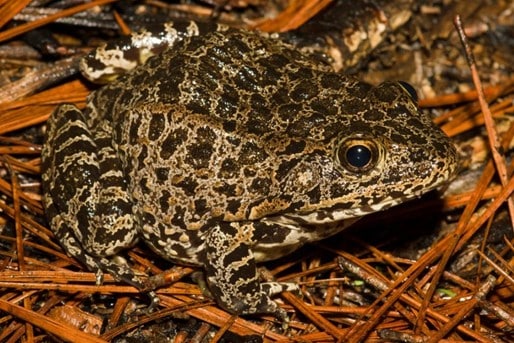
Adult Carolina gopher frog, Lithobates capito. Photograph courtesy of Kevin Stohlgren and Herps of NC.
As another April comes to a close, so does another Frog Month celebration. While Frog Month celebrates frogs and toads all around the world, it’s time to bring the celebration back to North Carolina. Therefore, it is only fitting that this month’s edition of North Carolina’s Weird and Wonderful feature an amphibian: the Carolina Gopher Frog, Lithobates capito. This incredibly secretive frog is hard to find in the wild and, in North Carolina, only occurs in the Sandhills and southeastern Coastal Plain. While it shares many physical traits with toads, gopher frogs are considered members of the “true frog” group, Lithobates. This species varies in coloration, ranging from pale gray or tan to even nearly black with many dark spots.
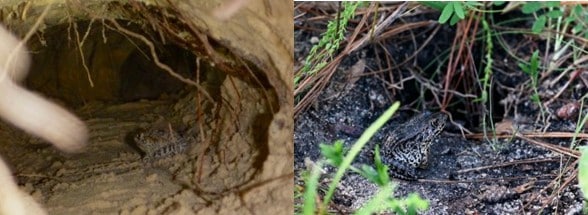
A gopher frog in a gopher tortoise burrow on the left, and a gopher frog resting in front of a stump hole on the right. Left photograph courtesy of Jonathan Mays, right photograph courtesy of Charles Dymock, and both photos courtesy of the Gopher Tortoise Council.
Gopher frogs (or Carolina Gopher frogs, as they’re known here in NC) are rare amphibians to come across. Pine savannas with sandy soils, especially turkey oak-longleaf pine plant communities, are their preferred habitat. Part of what makes this particular ecosystem such a great place for gopher frogs is that it is host to ephemeral ponds from the winter through spring. As these vernal pools are temporary and not connected to other water bodies, they do not contain fish, and thus are perfect, predator-free places in which gopher frogs can breed and lay eggs. The other aspect of pine savannas that makes them the perfect habitat for gopher frogs is the sandy soil, which is great for burrowing. Gopher frogs get their name from the fact that they are fossorial, meaning they live underground. In South Carolina and points south, they inhabit the burrows of gopher tortoises, which also inhabit turkey oak-longleaf pine savanna plant communities further south. In North Carolina, though, gopher tortoises are not present, so our gopher frogs make do with stump holes, crayfish burrows, and burrows made by other animals.
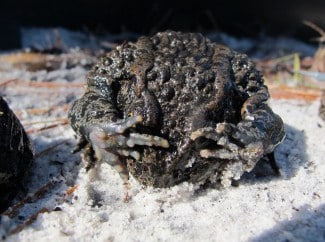
A gopher frog exhibiting defensive posturing. Photograph courtesy of the Gopher Tortoise Council.
Part of what makes gopher frogs so weird and wonderful is their terrestrial behavior: they only enter water to breed. Thus, their physical attributes are more toad-like to accommodate a less-watery lifestyle: drier skin and prominent warts. The dry skin helps hold in moisture, which is crucial for a fossorial amphibian. When threatened, gopher frogs arch their backs and cover their face with their hands. Researchers hypothesize that this is to protect their face while exposing the toxins that they secrete from their warts. These toxins make them an unpleasant snack for predators that may otherwise be tempted to eat them. While not seen very often, they can be heard calling during the breeding season, which is from mid-February through mid-April. The call is a deep snore or growl, and gopher frogs sometimes emit calls while fully submerged underwater.
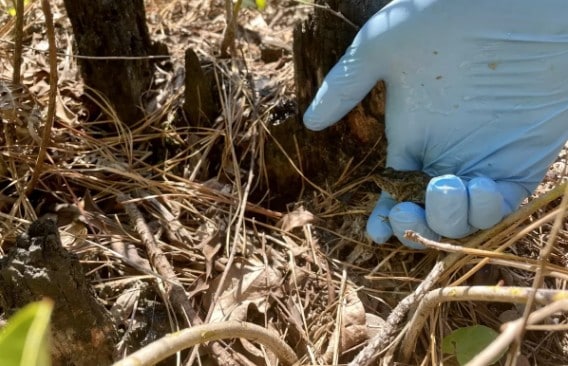
A juvenile gopher frog, raised in a head start program, released into the wild. Photograph courtesy of Gena Lyons and the U.S. Fish and Wildlife Service.
Unfortunately, gopher frogs are threatened or endangered throughout their entire southeastern range. This is due primarily to the destruction of their habitat due to agricultural and development pressures in the region. In addition, severe droughts result in ephemeral pools either not lasting for the full breeding season or not forming at all, denying gopher frogs places to breed. But all is not lost: federal, state, and private organizations, including the U.S. Fish and Wildlife Service, North Carolina Wildlife Resources Commission, North Carolina Aquariums, and the Amphibian Foundation, to name a few, have formed head start programs for gopher frogs. In these programs, gopher frogs are raised from the egg stage to froglet and then released into the habitat their ancestors were collected from, or into brand-new wetland habitat constructed especially for them. Individuals can help by working to conserve turkey oak-longleaf pine savanna habitat and to restore habitat that has been lost. The next time you find yourself in the pine savannas of the southeastern coastal plain, keep your eyes peeled for crayfish burrows and stump holes. You never know, there may be a gopher frog or two hanging out below ground.
#EarthDay #FrogMonth #CarolinaGopherFrog #AmphibianHeadStartPrograms #USFWS #NCWRC #NCAquariums #AmphibianFoundation #WetlandWednesday #NCWeirdandWonderful #TheSwampSchool