
The following blog post is a summary of the report Global Water Bankruptcy: Living Beyond Our Hydrological Means in the Post Crisis Era, published by the United Nations University Institute for Water, Environment, and Health on January 20, 2026. To read the full report, click here.

The United Nations University Institute for Water, Environment and Health report Global Water Bankruptcy: Living Beyond Our Hydrological Means in the Post Crisis Era presents a clear diagnosis that the world has entered a new and dangerous phase in its relationship with water. The report argues that decades of overuse have pushed many human water systems beyond their ability to recover, even during years with normal rainfall. Rivers, lakes, wetlands, aquifers, soils, and glaciers have been depleted or degraded faster than they can be replenished. This condition is described as global water bankruptcy, a state in which long term water use exceeds renewable inflows and safe depletion limits. The report emphasizes that this is not a future risk, but a present reality affecting societies on every continent.

Graphic courtesy of the United Nations University Institute for Water, Environment, and Health.
A central contribution of the report is its distinction between water stress, water crisis, and water bankruptcy. Water stress refers to high pressure on water resources that is still largely reversible with better management. Water crisis describes acute, time limited shocks such as droughts or floods that can, in principle, be overcome. Water bankruptcy, by contrast, is a persistent post crisis condition in which irreversible damage has already occurred. Compacted aquifers do not rebound, lost wetlands do not return, and disappearing glaciers cannot be restored within human time scales. According to the report, continuing to frame these conditions as crises obscures the true scale of the problem and encourages ineffective responses.

Graphic courtesy of the United Nations University Institute for Water, Environment, and Health.
The report documents extensive evidence of water bankruptcy across surface water, groundwater, food systems, and ecosystems. More than half of the world’s large lakes have lost water since the early 1990s, and around seventy percent of major aquifers show long term declining trends. Groundwater depletion has caused widespread land subsidence, affecting millions of square kilometers and putting billions of people at risk. Agriculture, which accounts for roughly seventy percent of global freshwater withdrawals, is increasingly undermined by declining water storage and degrading water quality. At the same time, pollution from wastewater, agriculture, and industry is shrinking the fraction of water that is safe and usable, even where total volumes appear stable.
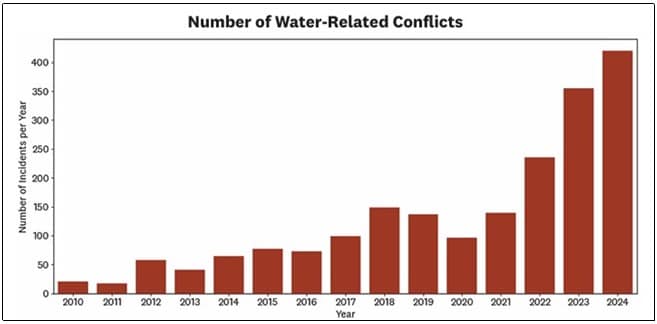
Graphic courtesy of United Nations University Institute for Water, Environment, and Health.
In response to these realities, the report calls for a shift from crisis management to water bankruptcy management. Rather than trying to restore past conditions that no longer exist, societies must acknowledge irreversible losses and adapt to permanently tighter hydrological limits. This includes rebalancing water rights and expectations, protecting remaining natural capital, and prioritizing basic human needs and ecosystem functions. The report stresses that water bankruptcy is also a justice and security issue, as its impacts fall most heavily on vulnerable communities. It concludes by urging the international community to use upcoming global milestones, including the UN Water Conferences in 2026 and 2028, to reset the global water agenda and align governance with hydrological reality.
#WaterBankruptcy #UNUINWEH #WaterSecurity #WetlandWednesday #TheSwampSchool