
The following blog post is a summary of the article “The History of America Flows Through the Hudson River, and the Country’s Aquatic Superhighway Is on the Rebound” by Rebecca Taylor, published in Smithsonian Magazine in December 2025. To read the original article, click here.
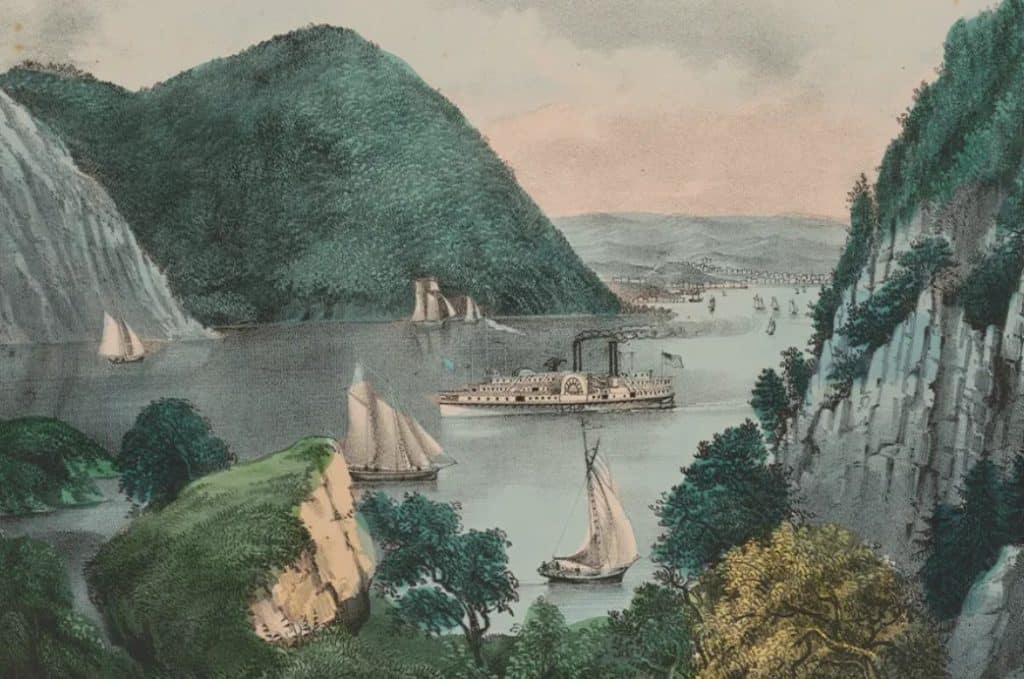
A print by Currier & Ives featuring the Crow’s Nest, a mountain along the west bank of the Hudson River, circa mid-to-late 19th century. Print courtesy of Smithsonian Magazine and the Library of Congress.
The Hudson River has played a central role in American history, culture, and geography for thousands of years. Long before European exploration, Native American communities traveled its waters and relied on its abundant fish populations. Formed by glaciers during the last Ice Age, the river stretches 315 miles through New York and functions as a tidal estuary, causing its current to reverse direction several times each day. Its unique characteristics and strategic location made it an important transportation route and natural landmark. Throughout history, the river has inspired artists, writers, naturalists, and political leaders who recognized its beauty and significance.
The Hudson River became deeply connected to the development of the United States through exploration, trade, warfare, and cultural expression. Henry Hudson explored the river in 1609, and during the American Revolution it served as a critical corridor linking different regions of the continent. Many notable figures, including George Washington, Sojourner Truth, Ulysses S. Grant, and Washington Irving, lived, worked, or drew inspiration from the river and its valley. The region also became famous through the Hudson River School of painters, whose landscapes celebrated its scenic grandeur. During the nineteenth century, the river supported growing industries, transportation networks, and tourism, helping to shape both the economy and identity of the nation.
Despite its importance, the Hudson River suffered severe environmental damage during the twentieth century as industrial pollution contaminated its waters. General Electric Company plants released large quantities of toxic chemicals into the river, contributing to widespread ecological decline and making the Hudson a national symbol of environmental degradation. Public activism, landmark legal victories, and stronger environmental laws eventually led to major cleanup efforts, including one of the largest federal dredging projects in United States history. These restoration initiatives have produced significant improvements, allowing species such as bald eagles, ospreys, sturgeons, and great blue herons to recover. Although conservation challenges remain, the river’s remarkable recovery demonstrates the impact of sustained environmental protection and public commitment.
#AmericanHistory #OnThisRiver #EnvironmentalHistory #HudsonRiver #RiverThatShapedANation #WetlandWednesday #TheSwampSchool