
The following blog post is a summary of the article “Data Drain: The Land and Water Impacts of the AI Boom” by Jon Gorey and published by the Lincoln Institute of Land Policy on October 17, 2025. To read the original article, click here.
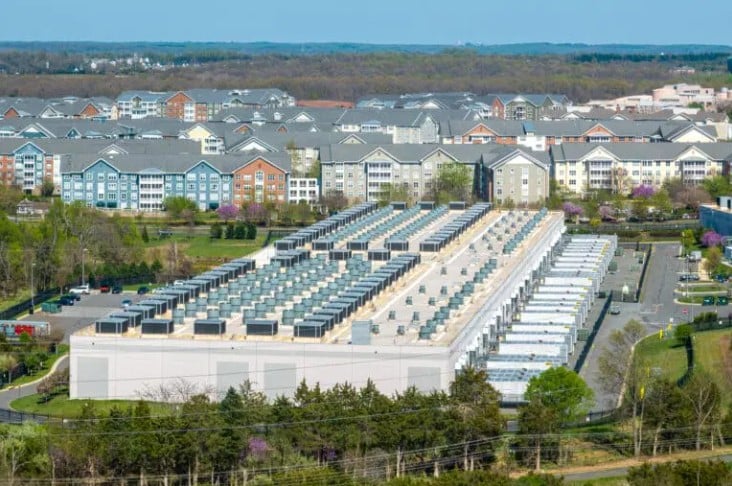
A data center abutting a residential neighborhood in Virginia. Photograph courtesy of Hugh Kenny, the Piedmont Environmental Council, and the Lincoln Institute of Land Policy.
Modern data centers are presented as resource intensive infrastructures that quietly but dramatically reshape local environments, economies, and public utilities. They are often compared to vampires due to their constant appetite for electricity, water, and land, as well as their tendency to operate out of public view. Across the United States, lawmakers are actively attracting these facilities with tax incentives, hoping to benefit from rapid growth driven by artificial intelligence. Even mid-sized data centers consume as much water as small towns and draw electricity comparable to tens of thousands of homes. As AI-focused hyperscale facilities multiply, their cumulative demands on power grids, water supplies, and land are increasing at a pace that often exceeds local planning and regulatory capacity.
The economic benefits associated with data centers are shown to be uneven and frequently overstated. Although some communities receive substantial tax revenues, these facilities create relatively few permanent jobs after construction is complete. Former corporate campuses that once supported thousands of workers are being replaced by massive, fenced off server buildings that offer little connection to surrounding neighborhoods. Meanwhile, the infrastructure required to power and support data centers brings air pollution, health risks, and climate impacts to nearby regions. Water use is especially concerning because much of it evaporates during cooling and never returns to local rivers or aquifers. Even reclaimed water use can deprive downstream communities, reinforcing the reality that water withdrawals have localized and lasting effects.
The rapid expansion of data centers highlights the need for more integrated planning, transparency, and oversight. Decisions about where and how these facilities are built involve trade-offs among water availability, energy production, land use, and climate goals. Heavy reliance on fossil fuel power increases both emissions and water consumption, while cleaner alternatives face political resistance and long development timelines. Infrastructure costs tied to data center growth are often shared across entire utility regions, raising electricity bills for customers who may not benefit from local tax gains. Addressing these challenges requires earlier community engagement, stronger state level coordination, and clearer disclosure from companies about resource use. The broader question remains whether the accelerating demand for artificial intelligence justifies the environmental and social costs concentrated in the places where data centers operate.
#AI #DataCenters #EnergyDemand #WaterUse #WetlandWednesday #TheSwampSchool