
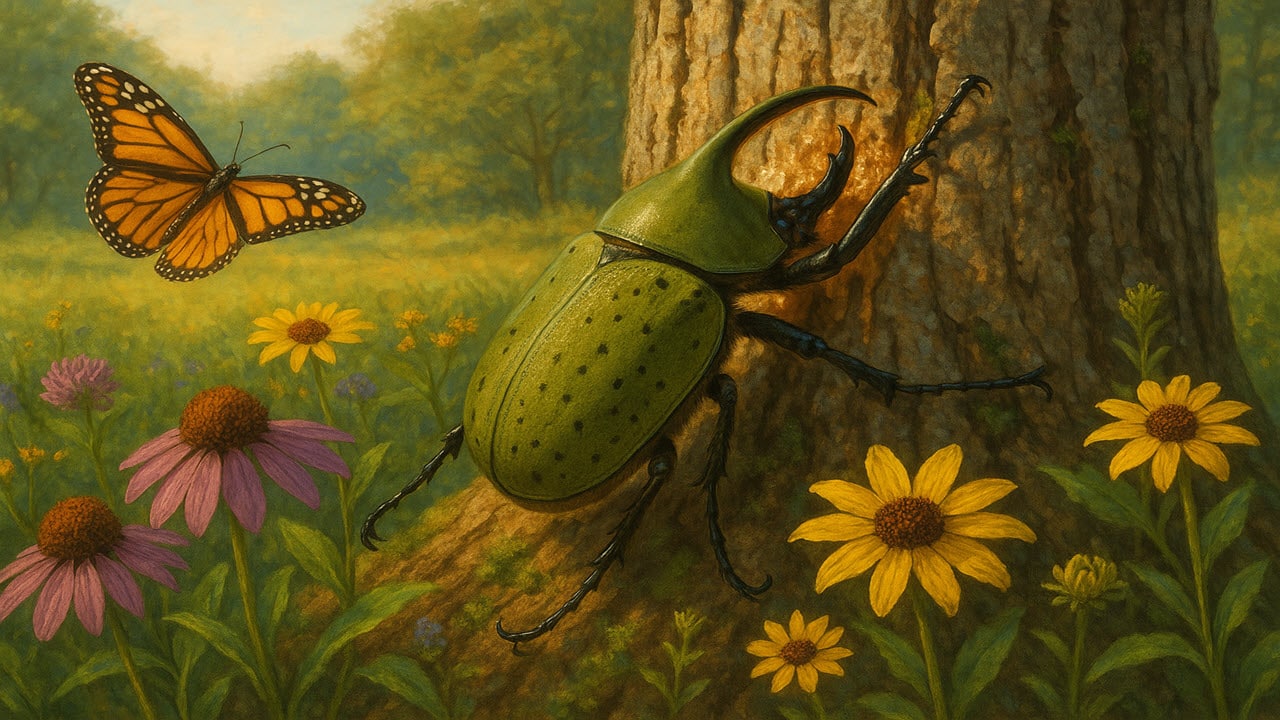
Spring has sprung in North Carolina. We have had our annual month-long experience of pollen coating everything, and now wildflowers are blooming, birds are singing, and the insects are waking up. I’ve already seen a few butterflies flitting about. Now, I know some of you are probably Lepidopteran fans, but me, I’m a Coleoptera person. For anyone unfamiliar with this lingo, Lepidoptera is the insect order containing butterflies and moths, while Coleoptera is the order containing beetles. I will probably discuss some of the more strange and unusual moths and butterflies in the future, but today, the time has come to talk about one of my favorite insect species, Dynastes tityus, otherwise known as the Eastern Hercules Beetle.

Male Dynastes tityus, the Eastern Hercules Beetle. Photo by Arthur B. Evans
The Eastern Hercules Beetle has the honor of being the largest beetle in the Eastern United States, coming in at 1 ½ -2 ½ inches in length. The color varies and depends on the moisture content in the environment. In dry conditions, these beetles are yellow-green to olive green in color; in wetter conditions, they are varying degrees of brown, depending on how much water they have absorbed. When humidity is very high, water will replace air in the voids within their body, leading to an increase in water absorption. If that wasn’t weird and wonderful enough, the pattern of spots and blotches on their elytra, the hard, outer wing covers, are thought to be unique to each individual. Thus, different individual adult beetles can be differentiated from one another. For anyone familiar with North American box turtle species, this is similar to how their unique shell patterns are used to tell each turtle apart, which is helpful for population studies in their native habitats.

Male Dynastes tityus peeling back the bark on an ash tree branch. Photo by John Bunch originally published in Banisteria.
Male Eastern Hercules Beetles have a large horn on their head that extends past their face, with three smaller horns on their pronotum, the dorsal body part sandwiched between the head and the elytra. Female Eastern Hercules Beetles lack horns and lay their eggs during the month of August, utilizing cavities at or near the base of several hardwood tree species, with large oaks tending to be the tree of choice. Once the larvae hatch, they feed on crumbling heartwood and rotten wood debris found in the cavity, and it can take as long as 2-3 years for them to pupate and turn into adult beetles. Adults feed on overripe and rotting fruit and tree sap, with ash tree species being a favorite. Indeed, a species observations note published in Entomological News way back in 1915 detailed 387 live specimens collected from a single ash tree! What an awesome sight that must have been to behold! The adult beetles grip a branch, peel the bark back, and feed on the resulting juices. Other insects may also get in on the fun and drink from the same scratch mark alongside an Eastern Hercules Beetle. Sadly, due to the invasive Emerald Ash Borer, a fellow beetle species, ash tree species all over the United States are dying. It is feared that the population of Eastern Hercules Beetle will dwindle, as there does not seem to be another group of tree species they favor as much for food as the ash group. There are treatments out there that have proven effective at treating and protecting ash trees from an Emerald Ash Borer infestation, so hopefully the ash tree population will begin to grow, and this big, beautiful bug, the Eastern Hercules Beetle, will be able to live its life in peace. The next time you stumble upon an ash tree in the summer, take a closer look. You might see some of these weird and wonderful beetles enjoying a cool drink on a hot day.