
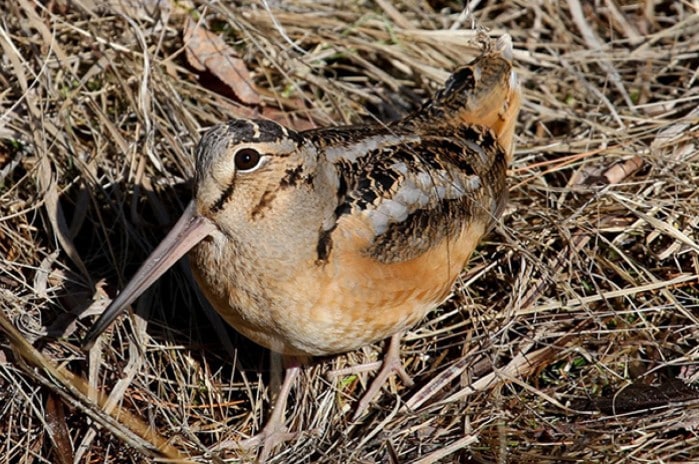
American woodcock, Scolopax minor. Also known as the timberdoodle or bogsucker. Photograph courtesy of the NC Wildlife Resources Commission.
The time to gorge oneself in the company of family and friends is once again upon us! In that spirit, this month’s edition of North Carolina’s Weird and Wonderful is going to focus on an edible species. A species that’s short and stout, and a bit odd looking. A species prized for its flavorful flesh perfectly packaged in individual portions. A species also known as the timberdoodle and the bogsucker. That’s right, it’s the American woodcock, Scolopax minor!
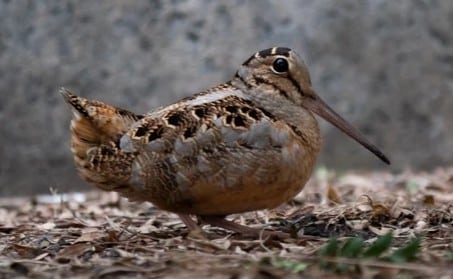
American woodcock, Scolopax minor. Photograph courtesy of Ryan Mandelbaum and the Audubon.
The American woodcock is a small bird, similar in size to a robin, with a very distinctive look. With its short legs, rotund, oval-shaped body, and a practically non-existent neck, one would be hard-pressed to mistake it for any other bird. They are related to sandpipers, but sandpipers have longer legs, longer necks, and occupy a very different habitat than the woodcock. American woodcocks occupy moist forests, shrubby wetlands, and thickets during the day, often venturing out into meadows, abandoned farm fields, and open wetland edges at night. They are primarily nocturnal, so that, combined with the fact that their plumage resembles the fallen leaves on a forest floor, makes them very hard to spot. Woodcocks, in contrast, have excellent eyesight due to the placement of their eyes far back in their head. You can’t see them, but they can definitely see you.
One of their weird and wonderful traits is their long, slender bill. Its tip is flexible and very sensitive, allowing American woodcocks to detect and quickly catch prey items in the soil, which are primarily earthworms, grubs, and other invertebrates. While walking and probing the moist earth with their beak, these birds walk in a weird rocking motion, which has caused some ornithologists to hypothesize that the vibrations from this strange gait may disturb worms into moving. Once they move, the woodcocks can quickly locate them with their bill and gobble them down. Naturalists in the past have described the sight of these birds swallowing prey as if they are slurping or sucking up the worms, hence the weirdly wonderful common name “bogsucker”.
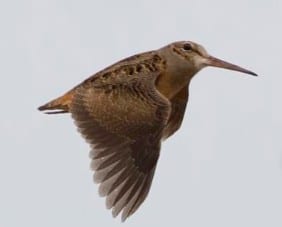
Adult American woodcock in flight. Photograph courtesy of All About Birds.
The call of the American woodcock is a loud, nasal beep often heard during their breeding season, which can begin as early as December in the southern portion of their range and as early as March in the northern portion. Males of this weird and wonderful species will utter a few beeps on the ground, and then begin their courtship flights, nicknamed “sky dance” by the late, great naturalist Aldo Leopold, at dawn and dusk to woo females. Special modified wing feathers are used to make musical twittering noises to aid in attracting females. Females and males do not form bonded pairs; males will mate with multiple females, and each female will scratch out a small depression on the forest floor. A single female will lay a clutch of four small, pinkish-buff colored eggs in this nest and sit on them four 20-22 days. The chicks, when they hatch, can leave the nest after a few hours, and after a few days they will start practicing catching food with their beak. The chicks will be fully independent around 5 weeks old.
One of the weird things about American woodcocks is that their migration and mating behaviors overlap. In many migratory bird species, mating and migrating happen during separate times. However, ornithologists have always been puzzled about why male woodcocks perform their mating displays along their migration routes, instead of only performing them once they have reached their final destinations. In addition, female woodcocks found nesting in the southern portion of their range have been found nesting again further north during the same breeding season. So, a team of researchers set out to solve the mystery by GPS-tagging over 200 female American woodcocks. They were able to track where each female traveled to along their migrations and found that around 80% of the females were mating, building nests, and rearing young as they traveled northward, a phenomenon known as itinerant breeding.
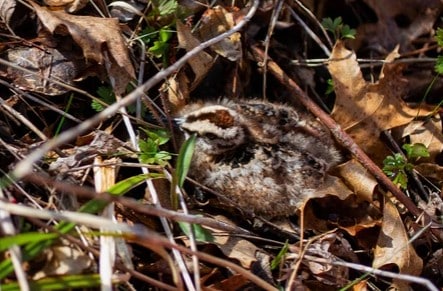
American woodcock chick found during the study on their reproductive habits during migration. Photograph courtesy of Mackenzie Brockman and Audubon.
Researchers hypothesize that this behavior increases the chances of reproductive success for each female, because woodcocks begin their spring migration as early as January in some locations. As they are ground-nesting birds, raising a brood on a cold forest floor, with very little brush coverage and perhaps even snow still on the ground, means that some females’ first nesting attempts in a breeding season may end unsuccessfully. However, future attempts during the same season may be successful, resulting in female woodcocks having a higher reproductive rate than birds that only rear one clutch a year.
More woodcock chicks mean more adult woodcocks, which are considered a delicacy by both game hunters and professional chefs alike. Here in North Carolina, hunting season for American woodcocks begins in early December and usually lasts through the end of January, with a limit of harvesting no more than three woodcocks a day. As the birds are small, it takes multiple hunting trips to acquire enough birds to make a satisfying portion, which is probably why this stout little bird has never become a holiday meal staple. Nevertheless, take a moment this Thanksgiving holiday to celebrate this nocturnal, wonderful bird who dances in the sky and slurps down worms. With a common name like timberdoodle, what’s not to love?
#AmericanWoodcock #Timberdoodle #Bogsucker #NCWildlife #NCWeirdandWonderful #WetlandWednesday #TheSwampSchool