
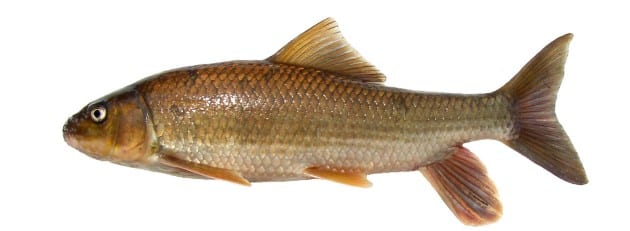
Holotype specimen of Moxostoma carolina, the Carolina Redhorse. Photograph by B.H. Tracy.
Another back-to-school season is upon us, and it’s the end of the month, which means it’s time for a North Carolina’s Weird and Wonderful article focusing on a species of fish! Why? Well, because fish swim in schools, so it all adds up. As I did some reading to find an interesting fish to talk about, it turns out North Carolina officially gained a new aquatic species this year: the Carolina Redhorse, Moxostoma carolina. I always learn so much about the wildlife that live in our state when I write these articles, and until fairly recently, I had no idea that North Carolina is a biodiversity hotspot for the fish genus Moxostoma. This is a fish genus that comprises many different kinds of sucker fish, of which the Carolina Redhorse is one.
Moxostoma species are ray-finned fish within the Catostomidae, or sucker fish, family. The genus name is Greek in origin, with stoma meaning mouth and moxo coming from the Greek word myxo, meaning mucus or slime. Sucker fish are bottom-feeders, using their sucker-like mouths to vacuum detritus, small molluscs, and aquatic insects from the beds of streams and rivers. Many species within this genus are large, strong fish, which is most likely where the “horse” portion of their moniker comes from. Redhorse species often have brightly colored scales in shades of red and orange, hence the “red” portion of their common name. The species now officially known as the Carolina Redhorse is only found in North and South Carolina, thus far the singular member of the Moxostoma genus that only resides within those two states. Carolina redhorses are incredibly rare, and are present in run-of-river reservoirs and streams in the Piedmont region of both states.
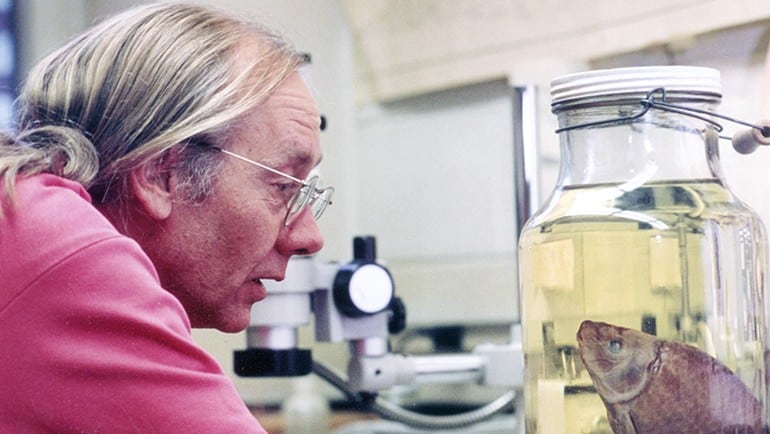
Dr. Robert E. Jenkins in his lab with a preserved fish specimen. Photograph courtesy of Roanoke College.
Specimens of this species were first collected in 1961 from Mill Creek in the Yadkin-Pee Dee River basin in North Carolina. It wasn’t until the 1990s that Dr. Robert E. Jenkins, an ichthyologist (a person who studies fish) who specialized in the Catostomidae family, recognized that the specimens represented a new, as-yet-undescribed species. He collected data on this new species for decades, but passed away in 2023 at the age of 83 before being able to publish his research and make it official. In a scientific article published this year in the journal Zootaxa, a group of ichthyologists have finally officially described the new species, posthumously attributing the majority of the research and credit to Dr. Jenkins. A beloved professor at Roanoke College in Salem, Virginia, Dr. Jenkins shared his love of fish with his students for over forty years, and inspired many young people to go into the ichthyology field.
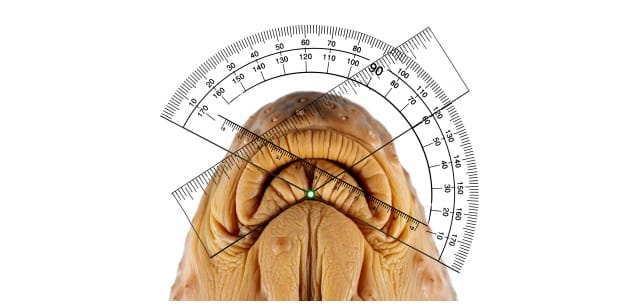
Example of how the lower lip angle is measured on Carolina Redhorse specimens. Photograph by J.L. Bissette and S.A. Smith.
Now, you might be thinking, a fish is a fish is a fish. How in the world can we know that some preserved specimens in jars in the Ichthyology Collection of the Research and Collections Division of the North Carolina Museum of Natural Sciences are in fact a new species of sucker fish? I’m glad you asked! It’s time to break out the calipers and measure the lower lip angle of some pickled fish! Isn’t science marvelous? Carolina redhorse fish have a lower lip angle of 117° falling within the 98-140° range. In addition, they can have 11-13 circumpeduncle scales, which are the scales that form a complete ring around the fish’s tail right before the tail fin. The holotype specimen, which is the specimen all Carolina Redhorse fish will be compared to, has 12 of these scales. Differences in the coloration and patterning of fleshy nodules on the face of the holotype and other specimens also helped distinguish it from other Moxostoma species. Driving the point home was genetic testing, which confirmed that the Carolina Redhorse was a genetically distinct species.
So, researchers now know this species exists, that its lower lip angle is important, and that close attention should be paid to the scales at the base of the tail and the fleshy bits on the face. What else do we know about the Carolina Redhorse? Not a lot, as it turns out. Adults grow to be large fish, ranging anywhere in size from a single foot to almost two feet in length, and color wise range from brown to copper orange. Ichthyologists hypothesize, based on morphological (shape, size, and structural) characteristics, that adults spawn in the spring from late April to early May on gravelly shoals in larger streams, but thus far spawning behavior has not been observed in the wild. Juvenile forms are very rare in research collections, perhaps due to the young fish moving into smaller, more shallow streams, which can be more difficult for researchers to sample. Similarly, adults are thought to congregate in larger, deep pools in rivers and large streams, which can only be sampled via boat electrofishers. Thus, ichthyologists rarely encounter Carolina Redhorses when sampling streams and rivers within their limited range.
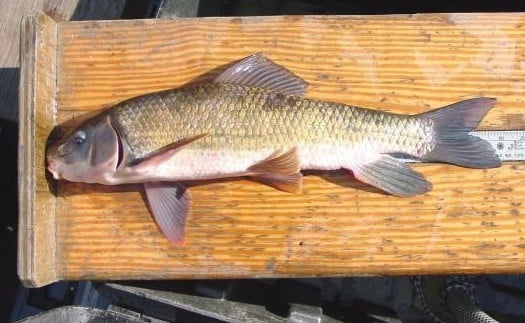
Carolina Redhorse. Photograph courtesy of the North Carolina Chapter of the American Fisheries Society and the US Fish and Wildlife Service.
Scientists with both the North Carolina Wildlife Resources Commission and the North Carolina Museum of Natural Sciences are working together to survey streams and rivers for these fish; PIT tag them with small, coded microchips; and release them back into the water. The hope is tracking their movements will provide biologists with more data on their population size, location, and maybe even spawning behavior. One day, breeding programs may be established to rear these fish in captivity, give young ones a headstart, and then release them back into the wild to boost their numbers. If there’s one thing that can be taken away from the Carolina Redhorse’s story, it’s this: scientific research is a team effort, often spanning decades. And the work isn’t over: this story is still being written, so the Carolina Redhorse is going to need more passionate ichthyologists, stream ecologists, and conservationists to continue unlocking their mysteries.
#CarolinaRedhorse #MoxostomaGenus #Ichthyology #NCMNS #NCWRS #NCAFS #USFWS #RoanokeCollegeVA #DrRobertEJenkins #NorthCarolinasWeirdandWonderful #WetlandWednesday #TheSwampSchool