
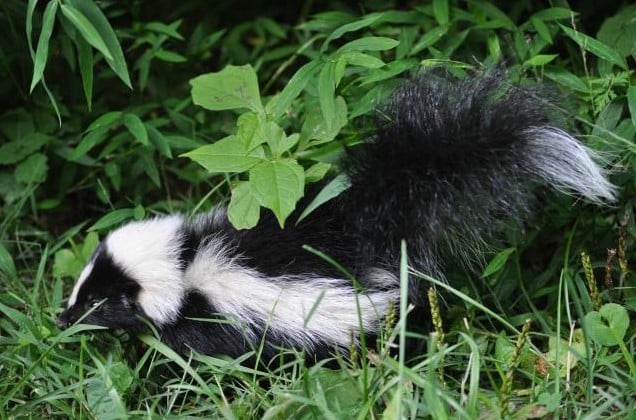
Striped skunk, Mephitis mephitis. Photo courtesy of Joe Shimel and Mammals of North Carolina.
Ah, love is in the air. Yes, I know it’s been a few weeks since Valentine’s Day, but for a certain non-human mammal in North Carolina, the season of romance is still underway. In fact, as you drive along the country roads and highways in our state, you may get a whiff of a pungent musk more often now than during other times of year. In case you haven’t guessed this month’s weird and wonderful focus yet, I will end your suspense: it’s the striped skunk. This house-cat-sized mammal, Mephitis mephitis, is on the prowl and looking for love.
The striped skunk is one of two skunk species in North Carolina, and, while found throughout our state, is more common in the mountains and becomes more scarce the further towards the coast you travel. Primarily nocturnal, striped skunks inhabit a wide range of natural spaces, including mountain forests, meadows, and cultivated lands, though they are seldom found in wetland habitats. These mammals are omnivorous and consume lots of insects, helping with pest control, but they also eat rodents, berries, fruits, eggs, and small amphibians and reptiles. Breeding season begins in mid to late February and continues into early March, which is why striped skunks tend to be seen (or smelled) more often during this time of year. After a gestational period of 59-77 days, litters ranging from 2 to 10 baby skunks are born. Opening their eyes for the first time around 22 days old, they are fully weaned by the time they are 8 weeks old. While striped skunks in captivity have lived to be over 10, most skunks in the wild live anywhere from 2 to 5 years.
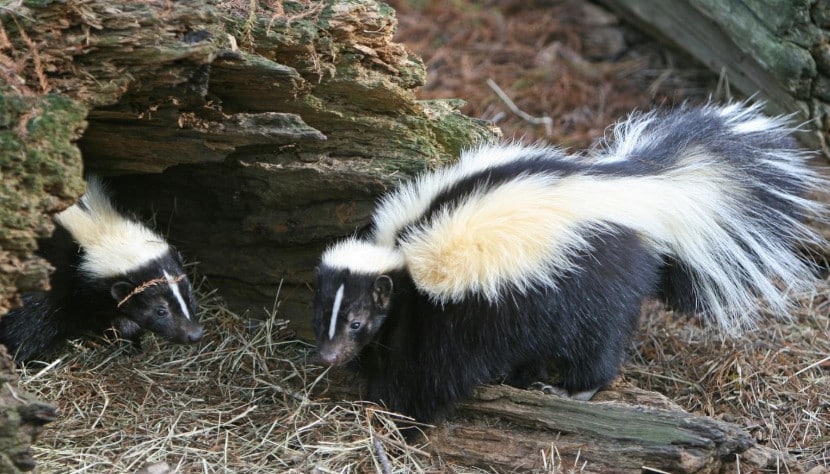
Striped skunks, Mephitis mephitis. Photograph courtesy of North Carolina Wildlife Resources Commission.
Striped skunks get their name from the two parallel white stripes that generally start as one stripe on their head and split into two around their shoulder blades. The stripes can be very broad, leaving a smaller patch of black fur on their back, or they can be thinner, resulting in a larger portion of their back being covered in black fur. Their bushy tails can be all white, all black, or a mix of the two colors. After their monochromatic appearance, striped skunks are best known for their ability to produce and spray a chemical secretion that causes great irritation to other mammals. When threatened, this species will stamp their feet, repeatedly click their teeth together, arch their back, and raise their tail to warn the intruder. If the perceived threat does not go away, the skunk will assume a U-shaped position, which enables the skunk to face the threat with both its eyes (so it can see the target) and its scent glands. Striped skunks can propel their stream of musk up to 6 yards away with incredible accuracy, a weirdly wonderful and smelly feat! While their stink has a strong effect on mammals, birds tend to not be affected, which is why the main predator of wild striped skunks is the great horned owl. Silent and deadly, these large birds of prey can swoop in and catch a skunk before they can even think about readying, aiming, and firing their chemical weapon.
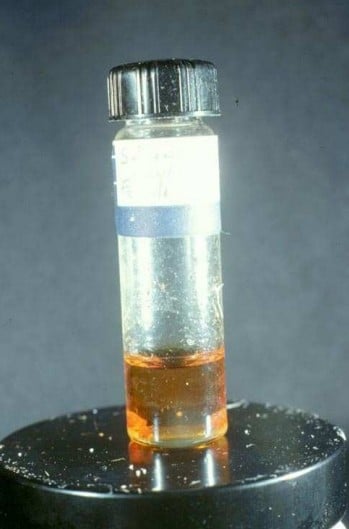
Sample of a striped skunk’s defensive secretion. Photograph courtesy of W.F. Wood and Cal Poly Humboldt.
Subsequent chemical analyses performed on striped skunks’ musk has revealed that it consists of thiols and thioacetates, primarily (E)-2-butene-1-thiol, 3-methyl-1-butane-thiol, and (S)-(E)-2-butene thioacetate. These chemical compounds cause an extreme reaction in mammals, especially if they get into their eyes or end up being ingested. There are even historical medical reports of people being rendered unconscious by high concentrations of striped skunk secretions. More often, though, people experience skunks secondhand through their pets’ interactions with them. While tomato juice has long been proclaimed the solution to skunk odor, research has shown that people tend to experience olfactory fatigue and fail to smell the secretion anymore, thus assuming the tomato juice has done its job. In reality, the thiol compounds are still there, and their presence is often confirmed by another person, fresh on the scene, exclaiming that the stink has not been eradicated and needs more tomato juice. The secret to dispelling the skunk odor is to oxidize the thiols to sulfonic acids, and there are many oxidizing agents that can get the job done. One of the better home remedies out there, developed by Mr. Paul Krebaum of Illinois from a laboratory method, is to bathe the afflicted pet in a mixture of 1 quart of 3% hydrogen peroxide, ¼ cup of baking soda, and a teaspoon of liquid detergent, taking care not to get the solution in the pet’s eyes or mouth. After five minutes, rinse the pet with water, and bathe again in the same solution if necessary. This mixture must never be stored in a closed container, as it releases oxygen and may result in the closed container exploding, and it needs to be used as soon as it is concocted. So, let’s give striped skunks some space while they engage in their romantic endeavors this February. It might be a good idea to stock up on some baking soda and hydrogen peroxide, though, just in case your dog ends up becoming a third wheel.