
It’s that wonderful time of year again: Halloween! Which means it is also time for this year’s October edition of North Carolina’s Weird and Wonderful! Last year, as you may recall, I was inspired by The Creature from the Black Lagoon and wrote about the two-toed amphiuma, one of our rarely seen aquatic amphibians. This year I’m sticking to land creatures, and, as I am in a ghost mood, have decided to focus on a glowing phantom of North Carolina forests: Omphalotus illudens, the jack-o-lantern mushroom.
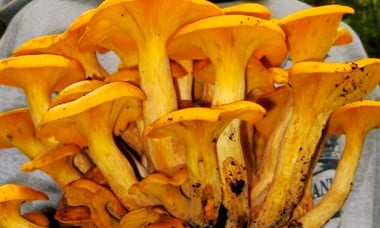
Clump of Omphalotus illudens, the Jack-O-Lantern mushroom. Photograph courtesy of Kathie Hodge and Cornell University’s Cornell Mushroom Blog.
Part of a larger family of mushrooms with bioluminescence as a defining trait, the jack-o-lantern mushroom found in North Carolina is large and grows in clusters, often at the base of stumps and dead hardwood trees. Oaks, it seems, are a favorite group for this mushroom, which emerges in late summer and early fall, right in time for the Halloween season. Its impeccable timing, combined with its glow-in-the-dark powers and bright orange to orange-yellow color, is what gives this mushroom its common name. So, how do jack-o-lantern mushrooms glow in the dark? This fungal species emits an eerie green light, which is made possible through the Caffeic Acid Cycle (CAC). In this cycle, caffeic acid is the raw material biosynthesized into the small molecule substrate luciferin. Luciferin is then catalyzed into luciferase, an enzyme that subsequently catalyzes a reaction with oxygen to produce light and more caffeic acid. If those names sound familiar, it’s because they were derived from the Latin word “lucifer”, which means “light-bearer”. It is hypothesized that jack-o-lantern mushrooms, and other bioluminescent fungi, evolved as “light-bearers” to attract insects, which help spread fungal spores. That’s pretty weird and wonderful, if you ask me.
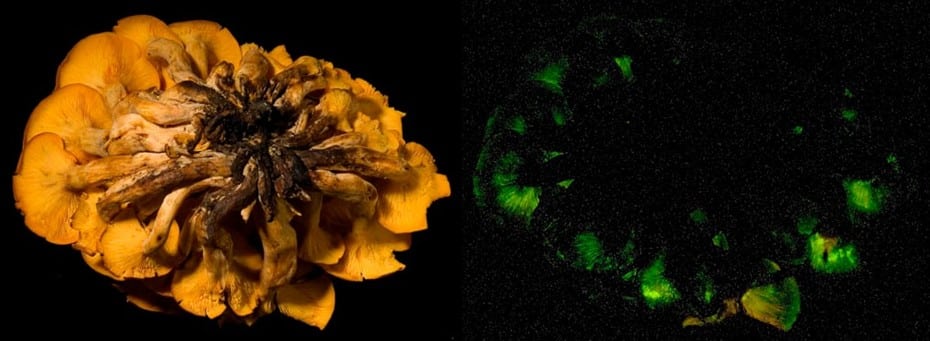
Jack-O-Lantern mushroom photographed without long-exposure, left, and photographed with long-exposure, right, to capture the bioluminescent light. Photographs courtesy of Kent Loeffler and Cornell University’s Cornell Mushroom Blog.
Now, while jack-o-lantern mushrooms look cool, under no circumstances should you ever try to eat one. Consuming some of these mushrooms will cause severe gastrointestinal distress. Unfortunately, some people confuse this species with the chanterelle mushroom, which is a popular edible fungus. Anyone interested in learning about mushroom foraging should work with a mycologist (someone who studies mushrooms) for a while until they are able to confidently identify by themselves which fungal species are safe to eat and which ones, like the weird and wonderful jack-o-lantern mushroom, should be left alone. So, while you’re out for a stroll or going trick-or-treating this Halloween season, keep your eyes peeled for a greenish glow in the forest. It might be North Carolina’s jack-o-lantern mushroom. Or, you know, a ghost.
#JackOLanternMushroom #Bioluminescence #ForestFinds #NorthCarolinasWeirdandWonderful #TheSwampSchool