
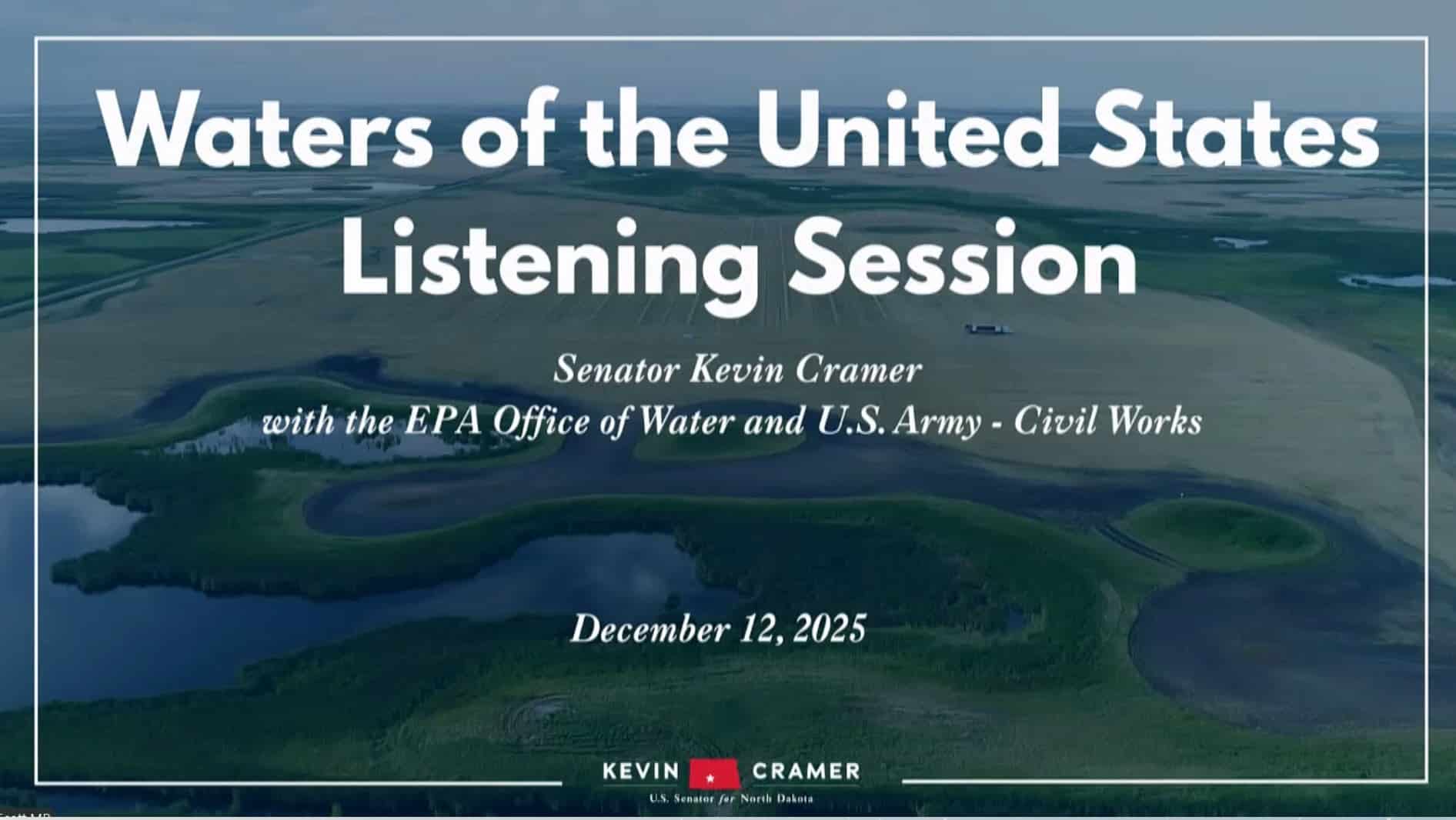
The first official public listening session on the proposed new definition of Waters of the United States (WOTUS) was held on December 12, 2025, in Bismarck, North Dakota. Hosted at Bismarck State College, the meeting brought together leadership from the U.S. Environmental Protection Agency, the U.S. Army Corps of Engineers, North Dakota state government, and Congress to discuss how the Clean Water Act will be implemented following the Supreme Court’s 2023 decision in Sackett v. EPA.
For wetland delineators, environmental consultants, engineers, regulators, farmers, and landowners, this meeting provided one of the clearest signals yet about how federal jurisdiction over wetlands, streams, prairie potholes, and ditches is changing under the new WOTUS rule.
The session opened with remarks from Dan Langan, Interim President of Bismarck State College, who emphasized the importance of aligning federal policy with real-world conditions in energy, agriculture, and workforce development. That theme carried through the entire meeting.
Senator Kevin Cramer of North Dakota framed the discussion around cooperative federalism, explaining that the Clean Water Act assigns primary responsibility for water management to the states, not Washington. He emphasized that prior WOTUS rules presumed federal jurisdiction over isolated wetlands, ephemeral streams, and dry land features, creating regulatory uncertainty and unnecessary permitting burdens. According to Senator Cramer, Sackett restores a clear legal boundary by limiting federal jurisdiction to relatively permanent waters and wetlands with continuous surface connections.
Governor Kelly Armstrong echoed those concerns, describing earlier WOTUS rules as an existential threat to North Dakota agriculture, ranching, and energy development. He pointed to prairie potholes and ephemeral drainages as examples of features that were swept into federal jurisdiction under prior interpretations, despite having little connection to navigable waters or interstate commerce. Governor Armstrong expressed support for the proposed WOTUS rule while emphasizing the need for precise definitions to prevent future expansion through interpretation.
Senator John Hoeven placed the rulemaking effort in historical context, noting years of litigation, congressional action, and regulatory reversals driven by shifting WOTUS definitions. He stressed that regulatory durability depends on strict adherence to Supreme Court precedent and respect for private property rights.
EPA leadership explained how the proposed rule implements Sackett v. EPA. Jessica Kramer, Assistant Administrator for EPA’s Office of Water, stated that the rule is designed to fully implement the Supreme Court’s direction, reduce regulatory burden, and restore cooperative federalism. She explained that wetlands and water features lacking continuous surface connections to relatively permanent waters—such as most prairie potholes—would generally fall outside federal jurisdiction. Peggy Brown, Principal Deputy Assistant Administrator for EPA’s Office of Water, emphasized that EPA and the Army Corps are focused on practical, field-level implementation and were in North Dakota to listen to stakeholder input.
Lee Forsgren, Principal Deputy Assistant Secretary of the Army for Civil Works, reinforced that Sackett resolved decades of legal ambiguity. After Sackett, the key jurisdictional question is no longer whether a feature meets a technical wetland definition, but whether it is indistinguishably part of a relatively permanent waterbody. This shift has significant implications for wetland delineation, jurisdictional determinations, and permitting under the Clean Water Act.
Public comments during the December 12, 2025 listening session reinforced these themes with real-world examples from agriculture, transportation, construction, engineering, and business.
The North Dakota Attorney General’s office described the state’s leadership in multi-state litigation challenging earlier WOTUS rules and the substantial public resources required to repeatedly fight federal overreach. Speakers emphasized that litigation should not be the primary tool for defining Clean Water Act jurisdiction, and that a clear, lawful WOTUS rule is essential to avoid continued court battles.
Agricultural testimony focused heavily on prairie potholes, ephemeral streams, and isolated wetlands. State agriculture officials explained that prairie potholes are typically shallow depressions that hold water only sporadically, often after rainfall or snowmelt. Under prior WOTUS rules, these features were frequently treated as jurisdictional waters, triggering federal permits for routine farming activities such as planting, fencing, drainage, and tile installation. Producers often had to hire environmental consultants, engineers, and attorneys to navigate permitting processes for land that was dry most of the year.
Transportation officials highlighted similar challenges with roadside ditches. The North Dakota Department of Transportation described how uncertainty over whether ditches were jurisdictional delayed projects, increased costs, and shortened already limited construction seasons. Roadside ditches are essential for drainage, snow storage, and roadway safety, and speakers urged EPA and the Army Corps to clearly exclude ditches that do not carry relatively permanent flow.
Engineering firms, builders, and contractors emphasized how shifting WOTUS definitions created confusion, inefficiency, and rising project costs. Several speakers explained that regulatory uncertainty directly affects housing affordability, with some developments incurring tens of thousands of dollars in additional costs per home before construction begins due to permitting and mitigation requirements.
Business organizations stressed that clear WOTUS definitions are critical for economic growth. In a state with short construction seasons, even small permitting delays can push projects back an entire year. Predictable Clean Water Act jurisdiction allows businesses to plan, secure financing, and invest with confidence.
State environmental regulators explained that waters not regulated under WOTUS are still protected under North Dakota law. The state regulates both surface water and groundwater and supports a WOTUS rule that aligns with Sackett while recognizing state primacy in managing water resources.
Farmers and ranchers returned repeatedly to the importance of clarity. Representatives from cattle and farm organizations explained that for decades, landowners have struggled to determine whether features on their own property were federally regulated. Prairie potholes, ephemeral tributaries, and isolated wetlands have long existed in jurisdictional gray areas, creating confusion, delays, and enforcement risk. Speakers emphasized that a workable WOTUS rule should allow an average landowner to walk their property and make a reasonable preliminary jurisdictional assessment without hiring specialists.
Across all testimony, several conclusions were consistent. Stakeholders broadly supported aligning WOTUS with Sackett v. EPA and narrowing federal jurisdiction to relatively permanent waters with continuous surface connections. Prairie potholes, ephemeral streams, roadside ditches, and isolated wetlands were repeatedly identified as features that should remain under state authority. Regulatory clarity, predictability, and durability were viewed as essential for effective wetland regulation, infrastructure development, agriculture, and economic growth.
Taken together, the December 12, 2025 WOTUS listening session demonstrated that Sackett has fundamentally reset Clean Water Act jurisdiction. The central question is no longer how broadly federal agencies can regulate wetlands and streams, but how narrowly federal authority must be defined to comply with Supreme Court precedent. For North Dakota and similar states, this shift represents a return to lawful, practical, and field-workable regulation grounded in science, constitutional limits, and cooperative federalism.